Semaglutide MASH evidence
Wegovy for MASH: Semaglutide Fatty-Liver Evidence and Label Limits
A research-backed guide to Wegovy for MASH, semaglutide fatty-liver evidence, biopsy endpoints, accelerated approval, side effects, and claim limits.

Wegovy entered a new liver-disease search category when FDA approved semaglutide injection for certain adults with metabolic dysfunction-associated steatohepatitis, or MASH, on August 15, 2025. That approval is easy to overread. It is not a general fatty-liver shortcut, not a cirrhosis indication, and not a reason to treat every semaglutide-containing product as equivalent to Wegovy.
MASH is the inflammatory and injury-related form of metabolic dysfunction-associated steatotic liver disease. Many people use "fatty liver" as a broad phrase, but the label question is narrower. The current Wegovy MASH indication applies to adults with noncirrhotic MASH with moderate to advanced liver fibrosis. That is a different intent from weight reduction alone, from Wegovy HD 7.2 mg dose headlines, and from broad GLP-1, GIP, glucagon, and amylin comparisons.
The useful way to read Wegovy for MASH is product first, indication second, evidence third. The molecule is semaglutide. The approved product is Wegovy injection. The labeled population is adults with noncirrhotic MASH and moderate to advanced fibrosis. The evidence includes biopsy-defined trial endpoints, not only liver enzymes or weight change.
Evidence Snapshot
| Common claim | Evidence picture | Boundary |
|---|---|---|
| Wegovy treats every kind of fatty liver disease. | FDA approval is for adults with noncirrhotic MASH and moderate to advanced fibrosis, not simple steatosis or cirrhosis. | A casual fatty-liver scan, liver-enzyme result, or online risk score is not the same as the labeled MASH population. |
| The MASH approval proves semaglutide fixes liver disease. | The approval was accelerated and based on histologic improvement in MASH and fibrosis measures in a defined trial setting. | Clinical-outcome confirmation, durability, cirrhosis prevention, liver-cancer outcomes, and individual response remain separate questions. |
| Wegovy HD 7.2 mg is the MASH dose. | Current Wegovy labeling lists 2.4 mg once weekly for MASH treatment, with indication-specific dosing language. | Higher-dose weight-loss labeling should not be copied into the MASH indication without matching label support. |
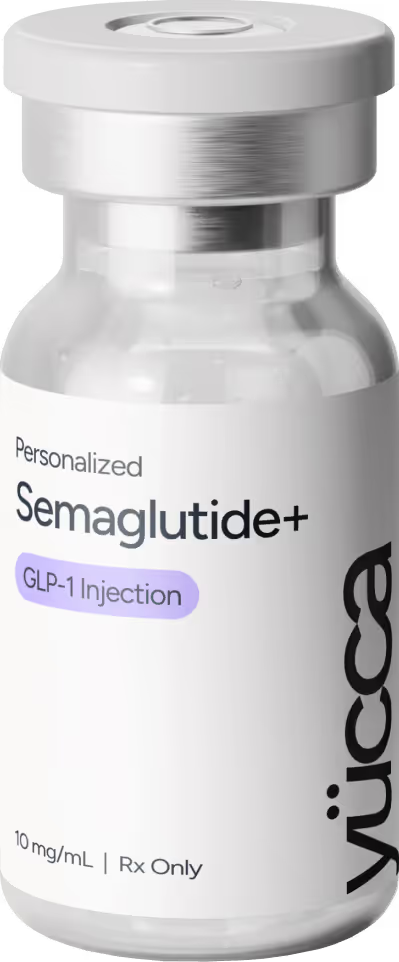
| Any semaglutide product inherits the MASH evidence. | The evidence and label belong to FDA-reviewed Wegovy injection, not research powders, compounded products, or informal oral products. | Product identity, formulation, sterility, stability, and lawful status are not solved by the active ingredient name. |
| Tirzepatide or retatrutide have the same MASH status. | Tirzepatide has MASH trial evidence but does not have the same FDA MASH approval. Retatrutide remains investigational. | Class-adjacent liver-fat headlines should not be treated as equivalent to a product-specific MASH label. |
What FDA Approved
FDA's approval notice describes Wegovy injection for MASH in adults with moderate to advanced fibrosis. The approval was granted under the accelerated approval pathway, which means the agency accepted an endpoint that can reasonably predict clinical benefit while requiring additional evidence to confirm how patients feel, function, or survive.
That detail matters because MASH is not measured like a scale-weight endpoint. Trial reports and FDA language focus on steatohepatitis resolution, fibrosis improvement, and lack of worsening in the paired liver condition. Those are histologic endpoints. They can be meaningful, but they are not the same as saying a person no longer has liver risk or no longer needs specialist monitoring.
The current label keeps the MASH dose distinct from other Wegovy contexts. For MASH treatment, Wegovy injection uses 2.4 mg once weekly as the maintenance dosage. The higher-dose Wegovy HD approval belongs to adult chronic weight reduction after tolerance of 2.4 mg and should not be imported into the MASH indication without a matching label.
This is also separate from the compounded semaglutide and tirzepatide rules. A product sold as semaglutide does not become Wegovy for MASH because the name is familiar. FDA-reviewed formulation, manufacturing, labeling, and clinical-study context all matter.
What The Trial Evidence Adds
The most relevant semaglutide source is the Phase 3 ESSENCE trial report in people with biopsy-defined MASH and fibrosis stage 2 or 3. Participants were assigned to once-weekly semaglutide 2.4 mg or placebo, with a long planned treatment period. The published interim analysis focused on histologic endpoints at week 72, while longer-term outcomes remain part of the ongoing evidence question.
That Phase 3 design is important because it sits closer to the FDA indication than older metabolic or weight-management trials. It studied a liver-disease population, used biopsy-defined entry criteria, and assessed MASH and fibrosis endpoints. It is still not a reason to generalize to people with simple steatosis, advanced cirrhosis, alcohol-related liver disease, or any unverified product.
It also explains why a clinician may talk about fibrosis stage, noninvasive risk markers, biopsy history, diabetes status, cardiometabolic risk, and competing causes of liver injury before discussing a medication. MASH care is not only a question of whether a drug can reduce weight. The label points to a defined disease state, and the practical decision depends on diagnosis, risk stratification, monitoring, concurrent metabolic disease, and contraindications.
Earlier semaglutide evidence also helps set boundaries. The 2021 placebo-controlled NASH trial studied once-daily subcutaneous semaglutide in biopsy-confirmed NASH with fibrosis. It reported a higher rate of NASH resolution without worsening fibrosis with semaglutide than placebo, but the confirmatory fibrosis endpoint was not met in the same way. That history explains why "liver inflammation improved" and "fibrosis improved" need to be read as separate endpoints.
Liraglutide also has older randomized NASH evidence through the LEAN study. That study supports the idea that GLP-1 receptor agonism has been studied in liver-disease contexts before Wegovy's MASH label, but it does not make every GLP-1 product interchangeable. Molecule, dose, route, duration, trial population, and regulatory status remain product-specific.
Tirzepatide is relevant because readers often compare tirzepatide with semaglutide in metabolic disease. The SYNERGY-NASH trial report studied tirzepatide in MASH with liver fibrosis and reported favorable histologic findings versus placebo. It is real human evidence, but it is not the same as a Wegovy MASH label. Tirzepatide's approved product labels and trial program should be read separately.
Other metabolic peptides can enter liver conversations in different ways. Tesamorelin, for example, has a separate evidence story around HIV-associated lipodystrophy and visceral fat, covered in our tesamorelin visceral-fat guide. Retatrutide remains investigational and should not be treated as an approved liver-disease therapy because of weight-loss or liver-fat headlines.
Where Marketing Usually Runs Too Far
The first overclaim is the word "fatty liver." A person can have metabolic steatosis without meeting the MASH and fibrosis criteria used in the label. A trial in MASH with fibrosis should not be rewritten into a consumer claim for every abnormal liver ultrasound.
The second overclaim is the assumption that weight loss explains everything. Weight reduction is relevant to MASH biology and trial interpretation, but the label and trials measure liver histology. A body-weight result, a liver-enzyme change, and fibrosis improvement are not interchangeable. A good claim should say which endpoint it is discussing.
Liver-enzyme changes can be especially tempting because they are easier to obtain than biopsy or imaging-based fibrosis assessment. They are useful clinical signals, but they are not a complete substitute for disease staging. A marketing claim built only on "ALT went down" or "liver support" language should be treated as weaker than a claim tied to a trial endpoint and a labeled population.
The third overclaim is product substitution. The reconstitution calculator can help readers understand milligrams, milliliters, and concentration. It cannot verify that a product is Wegovy, confirm sterility, establish a lawful compounding basis, or turn a research vial into an FDA-reviewed MASH treatment.
The fourth overclaim is class transfer. Oral GLP-1 pills, Wegovy injection, Ozempic, tirzepatide, retatrutide, and research-market peptides occupy overlapping search space. They do not share one evidence package. Route, product, dose, and indication should be named before a claim is taken seriously.
Side Effects And Label Warnings Still Matter
Wegovy's MASH approval does not remove the usual semaglutide safety frame. The label includes warnings for thyroid C-cell tumor risk language, acute pancreatitis, acute gallbladder disease, hypoglycemia risk with insulin or insulin secretagogues, acute kidney injury related to volume depletion, severe gastrointestinal adverse reactions, hypersensitivity reactions, diabetic retinopathy complications in diabetes, and pulmonary aspiration during anesthesia or deep sedation.
Gastrointestinal tolerability is especially relevant because MASH populations can have cardiometabolic comorbidities and concurrent medicines. Nausea, vomiting, diarrhea, constipation, and abdominal pain are not minor details when dehydration, medication absorption, diabetes treatment, or liver-disease monitoring are part of the clinical picture.
FDA has also warned about unapproved GLP-1 products used for weight loss. Those warnings are relevant here because a new liver indication can attract product pages that imply label-like status without label-like evidence. For broader context, pair this page with our GLP-1 side effects guide and approved vs investigational vs compounded vs research peptides.
How To Evaluate Wegovy MASH Claims
Start by asking whether the claim names the diagnosis. MASH with moderate to advanced fibrosis is not the same as fatty liver in casual speech. A useful claim should say whether the population is noncirrhotic, whether fibrosis stage matters, and whether diagnosis was biopsy-defined or inferred by noninvasive tests.
Next, check the endpoint. MASH resolution without worsening fibrosis, fibrosis improvement without worsening MASH, liver enzymes, liver fat, body weight, cirrhosis-free survival, symptoms, transplant risk, and cardiovascular outcomes are different measures. A claim about one endpoint should not be used as proof for another.
Then check the product. Wegovy injection has an FDA-reviewed MASH label. A semaglutide powder, compounded vial, oral product, imported pen, or research listing does not inherit that label. This distinction is the core reason Peptides Defined uses canonical product and peptide routes rather than loose ingredient shortcuts.
Finally, check whether the source is official, peer-reviewed, or anecdotal. Reddit and forums can reveal what people are asking about MASH, insurance, diagnosis, and access. They cannot prove histologic response or product equivalence. For MASH claims, the strongest sources are FDA labeling, FDA approval notes, PubMed-indexed trials, hepatology guidance, and clinician-supervised diagnosis.
The restrained takeaway is that Wegovy for MASH is a meaningful label expansion for semaglutide in a defined adult liver-disease population. It strengthens the evidence base for one approved product and one indication. It does not validate dose shortcuts, research-market substitutions, or broad fatty-liver claims.
References
- FDA Approves Treatment for Serious Liver Disease Known as MASH, U.S. Food and Drug Administration.
- Wegovy prescribing information, 2026 label, U.S. Food and Drug Administration.
- Phase 3 Trial of Semaglutide in Metabolic Dysfunction-Associated Steatohepatitis, New England Journal of Medicine / PubMed.
- Semaglutide 2.4 mg in Participants With Metabolic Dysfunction-Associated Steatohepatitis: Baseline Characteristics and Design of the Phase 3 ESSENCE Trial, PubMed.
- A Placebo-Controlled Trial of Subcutaneous Semaglutide in Nonalcoholic Steatohepatitis, New England Journal of Medicine / PubMed.
- Liraglutide safety and efficacy in patients with non-alcoholic steatohepatitis (LEAN), The Lancet / PubMed.
- Tirzepatide for Metabolic Dysfunction-Associated Steatohepatitis with Liver Fibrosis, New England Journal of Medicine / PubMed.
- Randomised clinical trial: Design of the SYNERGY-NASH phase 2b trial to evaluate tirzepatide as a treatment for metabolic dysfunction-associated steatohepatitis, PubMed.
- AASLD Practice Guidance on the clinical assessment and management of nonalcoholic fatty liver disease, PubMed.
- FDA Concerns with Unapproved GLP-1 Drugs Used for Weight Loss, U.S. Food and Drug Administration.
Disclaimer
This page is educational and is not medical advice. It does not provide prescribing, dosing, switching, compounding, reconstitution, sourcing, liver-disease diagnosis, fibrosis staging, weight-loss treatment, diabetes treatment, or individualized guidance for Wegovy, semaglutide, tirzepatide, retatrutide, tesamorelin, or related products. Liver-disease and medication decisions should be made with qualified healthcare professionals using current regulator-reviewed labels, diagnostic testing, and clinical context.
Next steps
Continue with the closest guide, peptide profile, or research tool.