Regulatory literacy
Compounded Semaglutide and Tirzepatide in 2026: What the FDA Rules Actually Say
A plain-English guide to GLP-1 compounding rules after shortage changes, including 503A, 503B, essentially-copy limits, salt forms, dosing errors, and red flags.

The phrase "compounded GLP-1" sounds simple, but in 2026 it sits at the intersection of FDA-approved products, drug-shortage policy, pharmacy compounding rules, active-ingredient sourcing, telehealth marketing, and patient-specific prescribing. That is why a useful article has to start with the regulatory category, not with the ingredient name.
This guide focuses on semaglutide and tirzepatide because they are the two names most readers encounter in weight-management discussions. It also explains why investigational GLP-1-related molecules such as retatrutide and cagrilintide should not be treated as just another compounding option.
Bottom Line
An FDA-approved semaglutide or tirzepatide product is not the same evidence object as a compounded vial, a bulk active ingredient, a salt form, a multi-ingredient mixture, or a product sold online with "research" language. The molecule name is only one part of the safety and legal question.
As of FDA's April 1, 2026 GLP-1 compounding update, semaglutide and tirzepatide do not currently appear on FDA's drug shortage list or on the 503B bulks list. On April 30, 2026, FDA also proposed excluding semaglutide, tirzepatide, and liraglutide from the 503B bulks list after finding no clinical need for outsourcing facilities to compound them from bulk substances.
That does not mean every individual compounding scenario can be reduced to one sentence. It does mean readers should be cautious when marketing claims imply that compounded GLP-1 products are generic, clinically identical, FDA-approved, shortage-authorized, or automatically lawful substitutes for approved medicines.
Current Status Snapshot
FDA's GLP-1 compounding position has changed as supply stabilized. Exact dates matter because older articles, clinic pages, and social posts may still repeat shortage-era assumptions.
| Topic | Current FDA context | Reader takeaway |
|---|---|---|
| Semaglutide injection | FDA announced on February 21, 2025 that the semaglutide injection shortage was resolved. In its April 1, 2026 GLP-1 compounding update, FDA stated that semaglutide does not currently appear on the 503B bulks list or on FDA's drug shortage list. | A compounded semaglutide product should not be treated as a routine interchangeable version of an approved semaglutide product. |
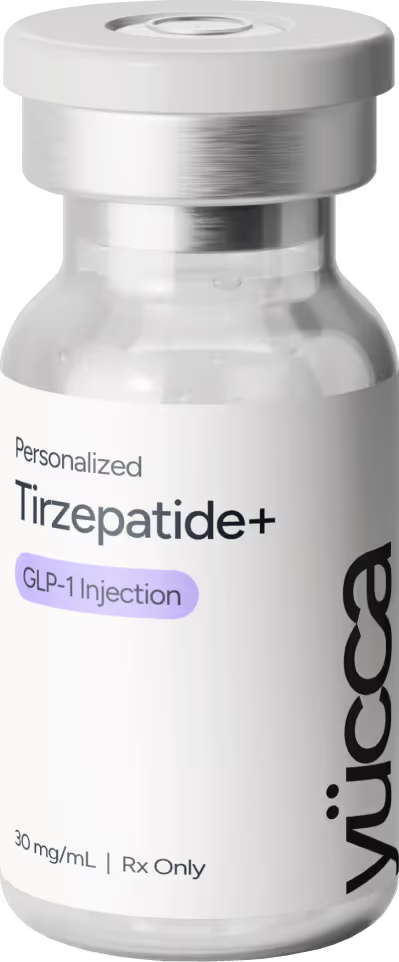
| Tirzepatide injection | FDA determined on December 19, 2024 that the tirzepatide injection shortage was resolved. In its April 1, 2026 update, FDA stated that tirzepatide does not currently appear on the 503B bulks list or on FDA's drug shortage list. | Claims that broad tirzepatide compounding is still justified by shortage status need careful checking against current FDA materials. |
| 503B bulk substances | On April 30, 2026, FDA proposed excluding semaglutide, tirzepatide, and liraglutide from the 503B bulks list after finding no clinical need for outsourcing facilities to compound them from bulk substances. | Outsourcing-facility bulk compounding is not simply a question of demand or price; FDA evaluates clinical need and statutory conditions. |
| Retatrutide and cagrilintide | FDA states that retatrutide and cagrilintide cannot be used in compounding under federal law and are not components of FDA-approved drugs. | Research interest, trial activity, and online availability do not make these investigational molecules lawful compounded products. |
Approved Product vs Compounded Product
FDA approval is product-specific. It applies to a particular formulation, route, device or presentation, manufacturer, label, warnings, contraindications, and indication. It does not automatically transfer to a pharmacy-made product that uses the same active ingredient name.
Compounded drugs can serve a medical need when an approved drug cannot meet an individual patient's needs. But FDA states that compounded drugs are not FDA-approved, which means the agency does not review them for safety, effectiveness, or quality before they are marketed.
| Category | What it means | Question to ask |
|---|---|---|
| Approved product | A specific drug product, formulation, route, manufacturer, label, and indication have gone through FDA review. | Is this exact product listed in FDA labeling or Drugs@FDA? |
| Compounded product | A pharmacy-prepared drug may be made for a patient-specific medical need under compounding rules, but it is not FDA-approved. | What patient-specific need is not met by an available approved product? |
| Bulk API | A bulk drug substance is an active ingredient used to make a compounded drug. Federal law limits when 503A pharmacies and 503B outsourcing facilities may use bulk substances. | Is the bulk substance permitted under the relevant 503A or 503B pathway? |
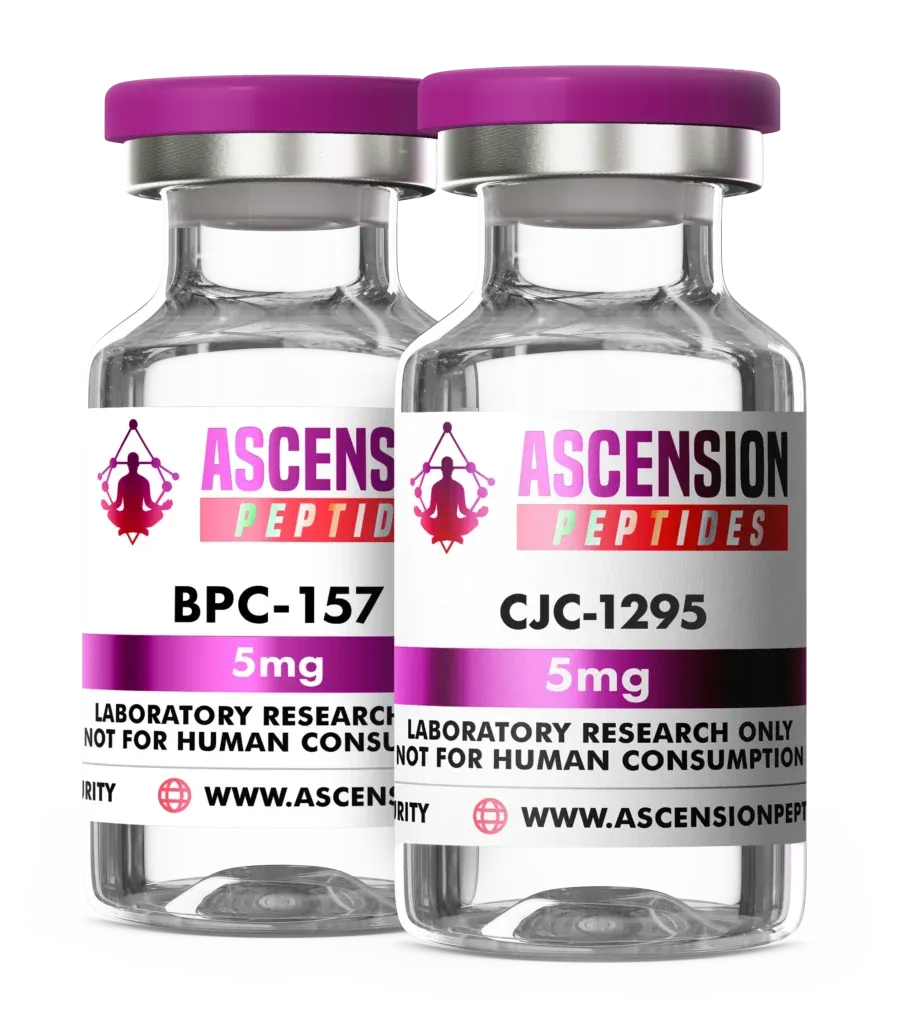
| Research-market product | A product sold online as research use, not for human consumption, or similar language is not an approved medicine and may still be illegally marketed if sold for human use. | Is the seller using research language while also giving human-use instructions? |
503A and 503B: Why the Pathway Matters
Section 503A generally refers to state-licensed pharmacy or physician compounding for an identified individual patient based on a prescription. FDA's April 2026 GLP-1 update emphasizes that the compounder may not compound, regularly or in inordinate amounts, products that are essentially copies of commercially available drug products.
Section 503B refers to registered outsourcing facilities. FDA states that outsourcing facilities are restricted from compounding drugs using bulk drug substances unless the substance appears on the 503B bulks list, or the drug compounded from the bulk substance is on FDA's drug shortage list at the time of compounding, distribution, and dispensing.
The practical difference is that "a pharmacy made it" is not enough detail. A reader needs to know whether the product is being framed as patient-specific 503A compounding, outsourcing-facility 503B compounding, or something outside those categories.
What "Essentially a Copy" Means
FDA's April 2026 update explains that it may consider a compounded drug product to be essentially a copy of a commercially available product when it has the same active pharmaceutical ingredient in the same, similar, or easily substitutable strength and can be used by the same route of administration, unless a prescriber documents a significant difference for an identified individual patient.
This matters for common marketing claims. A compounded GLP-1 product does not become a clearly different clinical product just because it is packaged in a vial, paired with a syringe, sold through a telehealth flow, or described as customized. The question is whether the specific statutory conditions are met.
FDA also gives an example involving semaglutide combined with another active ingredient such as vitamin B12. The presence of an additive does not automatically make a compounded drug meaningfully different if the product still meets FDA's essentially-copy framework.
Safety Issues FDA Has Flagged
FDA's unapproved GLP-1 materials describe several concerns with compounded and illegally marketed products. These include improper storage during shipping, fraudulent labels, unapproved online sales, adverse-event reports, salt forms, products sold falsely as research materials, and dosing errors.
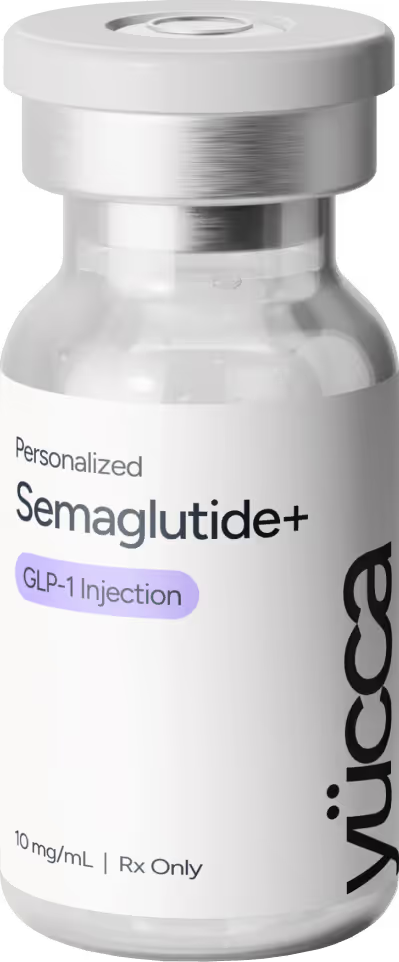
Dosing errors are especially relevant because approved injectable semaglutide products are supplied in standardized prefilled pens, while compounded versions may be dispensed in multi-dose vials at varying concentrations. FDA has received reports where confusion between milligrams, milliliters, and "units" contributed to overdose events, including some that required medical attention or hospitalization.
This is why reconstitution and unit math should be treated as measurement literacy, not medical authorization. Knowing how to convert volume, mass, and concentration does not establish that a product is lawful, appropriate, sterile, accurately compounded, or safe for a particular person.
Salt Forms, Additives, and "Same Active Ingredient" Claims
FDA has specifically warned that salt forms of semaglutide, including semaglutide sodium and semaglutide acetate, are different active ingredients than those used in approved semaglutide drugs. FDA states it is not aware of a lawful basis for their use in compounding.
Additives create a different problem. A seller may imply that semaglutide with B12, glycine, carnitine, or another ingredient is a unique therapy. But the regulatory question is not whether the label looks different. It is whether the compounded drug qualifies under the relevant compounding pathway and whether a prescriber has documented a significant patient-specific difference when needed.
The evidence question is separate from the legal question. Even when an additive is familiar, that does not prove the combined product has been studied for the same outcomes, adverse events, storage stability, dosing accuracy, or long-term safety as an approved GLP-1 product.
Retatrutide, Cagrilintide, and Newer Metabolic Peptides
Retatrutide and cagrilintide are often discussed near semaglutide and tirzepatide because they are part of the broader metabolic-drug conversation. That does not make them interchangeable in regulatory status.
FDA's GLP-1 concerns page states that retatrutide and cagrilintide cannot be used in compounding under federal law, are not components of FDA-approved drugs, and have not been found safe and effective for any condition. That is a different category from an approved product that temporarily appeared on a shortage list.
For readers, the safe interpretation is straightforward: a trial-stage molecule may be scientifically important and still not be an approved, compounded, or consumer product.
Red Flags In GLP-1 Compounding Marketing
Be cautious when a page uses familiar drug names but avoids the legal and product details. The most common red flags are:
- Calling a compounded product "generic Ozempic," "generic Wegovy," "generic Mounjaro," or "generic Zepbound."
- Claiming shortage status without naming the exact FDA shortage date and product.
- Using "same active ingredient" language without explaining FDA's copy framework.
- Promoting salt forms, custom mixtures, or B12 combinations as if they automatically solve regulatory limits.
- Selling research-use GLP-1 products with human-use instructions, dose charts, or before-and-after claims.
- Skipping pharmacy licensure, prescriber involvement, concentration, storage, and adverse-event reporting context.
The better question is not "is compounded semaglutide real?" It is: what exact product, made by whom, under which compounding pathway, from what active ingredient, for what patient-specific need, with what labeling, and under what current FDA status?
FAQ
Are compounded GLP-1 products FDA-approved?
No. Compounded products are not FDA-approved copies of Ozempic, Wegovy, Mounjaro, or Zepbound. They are regulated through different compounding pathways.
Why does shortage status matter?
Shortage status can affect whether compounders may make copies of approved products. Readers should check current FDA status and the specific pharmacy pathway.
Are salt forms and additives interchangeable?
No. Salt forms, added ingredients, and product-specific formulation choices can change the regulatory and safety question.
References
- FDA Clarifies Policies for Compounders as National GLP-1 Supply Begins to Stabilize, U.S. Food and Drug Administration.
- FDA Proposes to Exclude Semaglutide, Tirzepatide, and Liraglutide on 503B Bulks List, U.S. Food and Drug Administration.
- FDA's Concerns with Unapproved GLP-1 Drugs Used for Weight Loss, U.S. Food and Drug Administration.
- FDA Alerts Health Care Providers, Compounders and Patients of Dosing Errors Associated with Compounded Injectable Semaglutide Products, U.S. Food and Drug Administration.
- Understanding the Risks of Compounded Drugs, U.S. Food and Drug Administration.
- Bulk Drug Substances Used in Compounding, U.S. Food and Drug Administration.
- Medications Containing Semaglutide Marketed for Type 2 Diabetes or Weight Loss, U.S. Food and Drug Administration.
- FDA Intends to Take Action Against Non-FDA-Approved GLP-1 Drugs, U.S. Food and Drug Administration.
- FDA Warns 30 Telehealth Companies Against Illegal Marketing of Compounded GLP-1s, U.S. Food and Drug Administration.
- Compounding Risk Alerts, U.S. Food and Drug Administration.
Next steps
Continue with the closest guide, peptide profile, or research tool.