Profile snapshot
Quick facts
These fields are educational context only. Typical dose information is not dosing guidance.
- Type
- GLP-1 receptor agonist medicine
- Half-life
- About 1 week
- Typical dose
- Prescription-only; label-directed dosing varies by indication.
- Regulatory status
- FDA-approved for specific indications
Current status
Semaglutide is FDA-approved only in specific prescription products with brand-specific indications and labeling. Current as of May 23, 2026, this profile is educational and does not provide individualized treatment, dosing, compounding, or purchasing guidance.
Plain-English summary
Overview
Semaglutide is a long-acting glucagon-like peptide-1 receptor agonist, usually shortened to GLP-1 receptor agonist. It is the active ingredient in several FDA-approved branded medicines, including Ozempic, Wegovy, Rybelsus, and newer oral semaglutide tablet products with brand-specific labels. [1][2][3]
The important practical point is that "semaglutide" is not one generic internet product. Different approved brands, routes, strengths, devices, indications, and storage rules are governed by their own prescribing information. They should not be treated as interchangeable outside the directions of a licensed clinician and the official label. [1][2][3]
This page focuses on research literacy: what semaglutide is, how it is described in labels and major trials, what benefits have been reported in defined study populations, and what safety and handling issues readers should understand before interpreting online claims. [1][2][5][6][7]
- Primary drug class: GLP-1 receptor agonist. [1][2]
- Routes in approved U.S. products: subcutaneous injection and oral tablets, depending on brand and indication. [1][2][3]
- Evidence base: large randomized trials in type 2 diabetes, chronic weight management, cardiovascular outcomes, chronic kidney disease in type 2 diabetes, and MASH. [4][5][6][7][8]
How it works biologically
Mechanism
Official labeling describes semaglutide as a GLP-1 analogue that binds to and activates the GLP-1 receptor. GLP-1 signaling is involved in glucose regulation, appetite, and caloric intake, which is why the same active ingredient can appear in both diabetes and weight-management contexts. [1][2]
In people with type 2 diabetes, semaglutide lowers elevated blood glucose in a glucose-dependent way by increasing insulin secretion and reducing glucagon secretion. Because this effect is glucose-dependent, hypoglycemia risk is especially important when semaglutide is combined with insulin or insulin secretagogues. [1][3]
Semaglutide also delays gastric emptying. That helps explain both part of its post-meal glucose effect and some of the gastrointestinal tolerability issues seen in labels and trials. Labels also warn that delayed gastric emptying can affect absorption of some oral medications. [1][2][3]
For weight reduction, labeling describes GLP-1 receptors in brain regions involved in appetite regulation. For cardiovascular risk reduction and MASH, the full clinical mechanism is not reduced to one pathway; official labeling notes that the exact mechanism for cardiovascular risk reduction has not been established. [2][4]
Label status as of May 23, 2026
Approved Uses / Evidence
Ozempic injection is FDA-labeled for adults with type 2 diabetes as an adjunct to diet and exercise to improve glycemic control, to reduce major adverse cardiovascular events in adults with type 2 diabetes and established cardiovascular disease, and to reduce the risk of sustained eGFR decline, end-stage kidney disease, and cardiovascular death in adults with type 2 diabetes and chronic kidney disease. [1]
Rybelsus and Ozempic oral tablets are labeled for adults with type 2 diabetes to improve glycemic control and to reduce major adverse cardiovascular events in adults with type 2 diabetes who are at high risk for these events. Their label states that the tablet products are not substitutable on a milligram-to-milligram basis. [3]
Wegovy injection is labeled for chronic weight reduction in adults and adolescents with obesity, and in adults with overweight plus at least one weight-related condition, alongside reduced calorie intake and increased physical activity. It is also labeled to reduce major adverse cardiovascular events in adults with established cardiovascular disease and obesity or overweight. [2][6]
Wegovy injection is also FDA-approved, under the accelerated approval pathway, for adults with noncirrhotic metabolic dysfunction-associated steatohepatitis, or MASH, with moderate to advanced liver fibrosis. Continued approval may depend on confirmatory clinical benefit data. [2][4]
Because these approvals are product- and population-specific, trial results should not be generalized to every person using any semaglutide-containing product. The evidence describes defined study populations, eligibility criteria, endpoints, and monitored clinical settings. [1][2][5][6][7][8]
What major studies reported
Benefits Discussed in Trials
In STEP 1, a randomized trial in adults with overweight or obesity without diabetes, once-weekly semaglutide 2.4 mg plus lifestyle intervention produced substantially greater mean weight reduction over 68 weeks than placebo plus lifestyle intervention. This trial helped establish the chronic weight-management evidence base for semaglutide 2.4 mg. [2][5]
In SELECT, adults with obesity or overweight and established cardiovascular disease, but without diabetes, had fewer major adverse cardiovascular events with semaglutide 2.4 mg than with placebo. The primary composite outcome was cardiovascular death, nonfatal myocardial infarction, or nonfatal stroke, and the trial reported a hazard ratio of 0.80. [2][6]
In SUSTAIN-6, adults with type 2 diabetes at high cardiovascular risk had a lower rate of the primary cardiovascular composite endpoint with semaglutide than with placebo. The trial also reported more diabetic retinopathy complications in the semaglutide group, which is reflected in current labeling as a monitoring issue for patients with diabetic retinopathy history. [1][8]
In FLOW, adults with type 2 diabetes and chronic kidney disease had a lower risk of major kidney disease events with semaglutide than with placebo. This evidence supports the Ozempic kidney-risk-reduction labeling for adults with type 2 diabetes and chronic kidney disease. [1][7]
For MASH, FDA described interim phase 3 evidence at week 72 showing higher rates of MASH resolution without worsening fibrosis and higher rates of fibrosis improvement without worsening MASH in the Wegovy group than placebo. The trial is continuing to assess whether these histology changes translate into longer-term clinical outcomes. [2][4]
Risk context
Safety Context
FDA-approved semaglutide labels carry a boxed warning for thyroid C-cell tumors observed in rodents. The labels contraindicate use in people with a personal or family history of medullary thyroid carcinoma or multiple endocrine neoplasia syndrome type 2. [1][2][3]
Common adverse reactions in labels and trials are often gastrointestinal, including nausea, vomiting, diarrhea, constipation, abdominal pain, dyspepsia, and related symptoms. Severe gastrointestinal adverse reactions are also included in current warnings, and labels state semaglutide products are not recommended in patients with severe gastroparesis. [1][2][3]
Other labeled safety issues include acute pancreatitis, gallbladder disease, acute kidney injury related to volume depletion, hypersensitivity reactions, pulmonary aspiration risk during anesthesia or deep sedation, and hypoglycemia risk when combined with insulin or insulin secretagogues. [1][2][3]
Diabetic retinopathy deserves specific attention in diabetes populations. Ozempic labeling notes that diabetic retinopathy complications occurred more often with semaglutide than placebo in a cardiovascular outcomes trial, especially among patients with pre-existing retinopathy. [1][8]
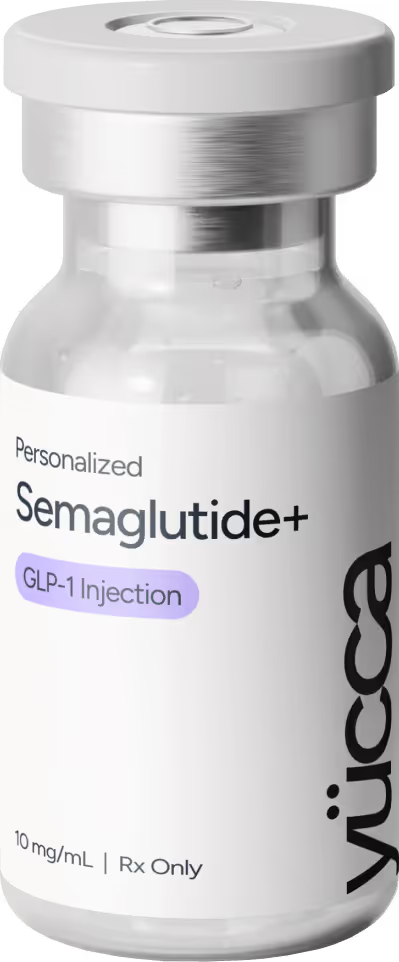
FDA has separately warned about unapproved GLP-1 products and compounded semaglutide, including dosing errors, hospitalizations, and salt forms such as semaglutide sodium or semaglutide acetate that are different active ingredients from those used in approved products. This page does not provide compounding, vial reconstitution, or purchasing guidance. [9]
Official-label handling only
Storage and Handling From Official Labeling
Storage instructions are product-specific. A general online claim such as "keep semaglutide cold" is not a substitute for the label on the exact FDA-approved product a patient has been prescribed. [1][2][3]
Ozempic injection labeling states that new, unused pens should be refrigerated at 36 to 46 degrees F, while an in-use pen may be stored for 56 days at room temperature or in a refrigerator. The label also says not to freeze Ozempic and to keep it away from heat and light. [1]
Wegovy injection labeling similarly uses refrigerated storage for unused pens and includes product-specific room-temperature handling limits. The Wegovy tablet label uses room-temperature storage in the original container, with dry conditions and moisture protection. [2]
Rybelsus and Ozempic tablets should be stored at controlled room temperature, kept dry, and stored in the original bottle until use to protect from moisture. Tablets should not be moved into pill organizers unless the official label for the exact product allows it. [3]
These handling notes are not instructions for research powders, compounded vials, or non-approved products. For those products, the key issue is that FDA labeling, manufacturing controls, and device-specific instructions may not apply. [9]
FAQ
Is semaglutide FDA-approved?
Yes, but only as specific FDA-approved prescription products with brand-specific indications. Approved labeling differs across Ozempic, Wegovy, Rybelsus, and oral tablet products, so the active ingredient should not be treated as one interchangeable product. [1][2][3]
Is semaglutide the same thing as retatrutide or tirzepatide?
No. Semaglutide is a GLP-1 receptor agonist. Tirzepatide targets GIP and GLP-1 receptors, while retatrutide is an investigational triple agonist designed for GIP, GLP-1, and glucagon receptors. [1][2]
Does semaglutide cause weight loss in everyone?
No. Trials report group averages in defined populations, not guaranteed individual outcomes. Response, tolerability, contraindications, comorbidities, and adherence to the studied program all matter. [2][5]
Why do some semaglutide products have diabetes labels and others have weight-management labels?
FDA approvals are based on specific product applications, doses, routes, trials, endpoints, and populations. The same active ingredient can appear in different branded products with different evidence packages and labeling. [1][2][3]
Can compounded semaglutide be assumed equivalent to an FDA-approved product?
No. FDA has warned about unapproved GLP-1 drugs and compounded semaglutide, including dosing errors and salt forms that differ from the active ingredient in approved products. [9]
Does this page give a dose or treatment plan?
No. Trial and label references are included only to explain the evidence base. This site does not provide individualized dosing, treatment protocols, reconstitution instructions, or purchasing guidance.
References
-
[1] Ozempic (semaglutide) injection prescribing information
Novo Nordisk / FDA labeling. Revised May 2026.
https://www.novo-pi.com/ozempic.pdf -
[2] Wegovy (semaglutide) injection and tablets prescribing information
FDA AccessData. Revised February 2026.
https://www.accessdata.fda.gov/drugsatfda_docs/label/2026/215256s033lbl.pdf -
[3] Rybelsus and Ozempic tablets prescribing information
Novo Nordisk / FDA labeling. Revised January 2026.
https://www.novo-pi.com/rybelsus.pdf -
[4] FDA Approves Treatment for Serious Liver Disease Known as MASH
U.S. Food and Drug Administration. August 15, 2025.
https://www.fda.gov/drugs/news-events-human-drugs/fda-approves-treatment-serious-liver-disease-known-mash -
[5] Once-Weekly Semaglutide in Adults with Overweight or Obesity
New England Journal of Medicine. March 18, 2021.
https://www.nejm.org/doi/full/10.1056/NEJMoa2032183 -
[6] Semaglutide and Cardiovascular Outcomes in Obesity without Diabetes
New England Journal of Medicine. December 14, 2023.
https://www.nejm.org/doi/full/10.1056/NEJMoa2307563 -
[7] Effects of Semaglutide on Chronic Kidney Disease in Patients with Type 2 Diabetes
New England Journal of Medicine. July 11, 2024.
https://www.nejm.org/doi/full/10.1056/NEJMoa2403347 -
[8] Semaglutide and Cardiovascular Outcomes in Patients with Type 2 Diabetes
New England Journal of Medicine / PubMed. November 10, 2016.
https://pubmed.ncbi.nlm.nih.gov/27633186/ -
[9] FDA Concerns with Unapproved GLP-1 Drugs Used for Weight Loss
U.S. Food and Drug Administration. Current FDA safety information.
https://www.fda.gov/drugs/postmarket-drug-safety-information-patients-and-providers/medications-containing-semaglutide-marketed-type-2-diabetes-or-weight-loss