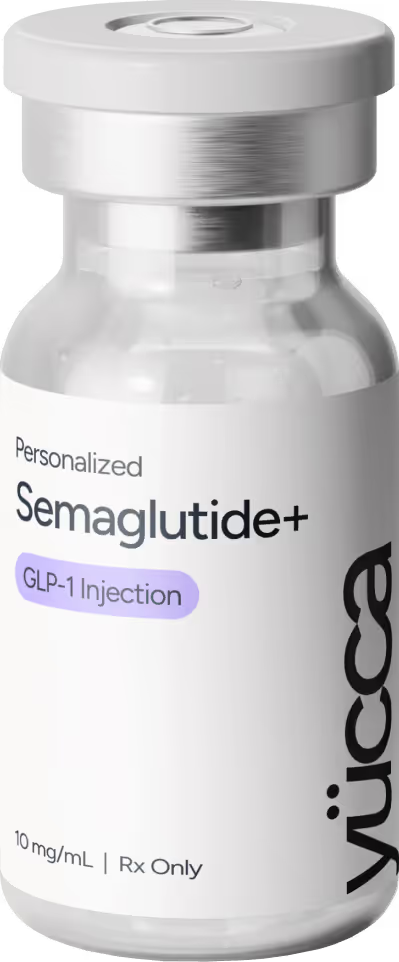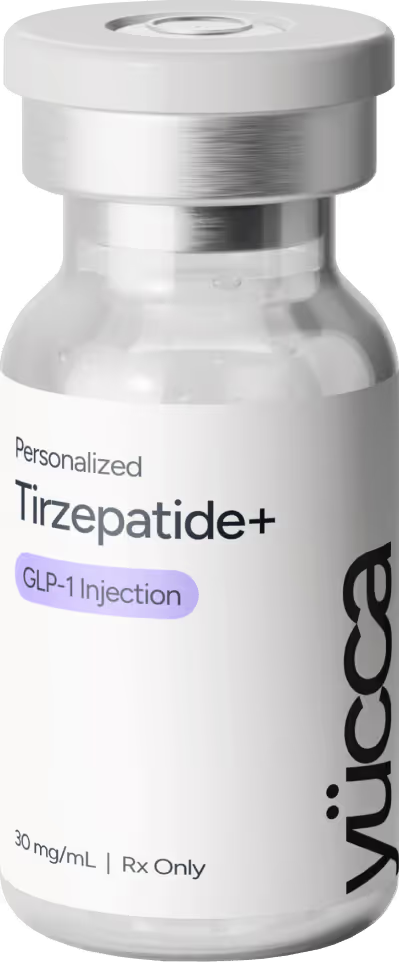
Psychiatric safety evidence
GLP-1 Suicidal Ideation Claims: FDA Review, Label Changes, and Human Evidence
A research-backed guide to GLP-1 suicidal ideation claims, FDA 2026 label-change requests, semaglutide and tirzepatide evidence, and psychiatric safety limits.

GLP-1 suicidal ideation claims became a high-demand search topic after adverse-event reports and regulator reviews raised a difficult safety question: could medicines such as semaglutide or tirzepatide increase suicidal thoughts or behavior in people using them for diabetes or weight reduction?
The answer changed in a concrete way on January 13, 2026. FDA requested that application holders remove suicidal ideation and behavior warning language from GLP-1 receptor agonist medicines that included it, specifically Saxenda, Wegovy, and Zepbound. FDA said its comprehensive review did not identify an increased risk of suicidal ideation or behavior with GLP-1 receptor agonist medications.
That does not mean psychiatric symptoms can be ignored. It means the best current source reading is narrower than many headlines: reports prompted review, the review did not support an increased risk, and people with new or worsening depression, suicidal thoughts, or unusual mood or behavior changes still need clinical evaluation. This is a safety-claim article, not a mental-health triage tool.
Evidence Snapshot
| Common claim | Evidence picture | Boundary |
|---|---|---|
| GLP-1 drugs are proven to cause suicidal thoughts. | FDA requested removal of suicidal ideation and behavior warning language from certain GLP-1 weight-reduction labels after a comprehensive review found no increased risk. | That finding does not replace mental-health evaluation for anyone with new or worsening symptoms. |
| The warning removal means psychiatric symptoms do not matter. | FDA still advises patients to discuss new or worsening depression, suicidal thoughts, or unusual mood or behavior changes with healthcare professionals. | A label review is not a personal mental-health assessment. |
| Ozempic, Wegovy, Zepbound, and research products share one label. | Wegovy and Zepbound weight-reduction labels had suicidal ideation warning language removed in 2026; diabetes-only GLP-1 labels did not carry the same warning language. | Product, indication, route, dose, and regulatory status still matter. |
| Forum reports establish causality. | Case reports and adverse-event reports helped trigger reviews, but FDA weighed trials, Sentinel claims data, observational studies, and published analyses. | A report can identify a concern without proving that the medicine caused a specific event. |
| Any online GLP-1 product inherits FDA-reviewed safety conclusions. | FDA label and Sentinel findings apply to regulated medicines and specific review questions, not to unknown compounded or research-market products. | Product identity, dosing accuracy, sterility, labeling, and monitoring are separate issues. |
What FDA Reviewed In 2026
FDA's 2026 communication is the central source for current U.S. label interpretation. FDA said the affected products were Saxenda, Wegovy, and Zepbound, all approved for weight reduction in people with obesity or overweight. The agency also explained why the original warning language existed: similar information had appeared in labels for other weight-loss medicines and was based on events observed with older medicines used or studied for weight loss.
FDA reviewed multiple evidence streams. The agency described a meta-analysis of 91 placebo-controlled GLP-1 receptor agonist trials with 107,910 patients. The results did not show an increased risk of suicidal ideation or behavior, or other relevant psychiatric adverse events such as anxiety, depression, irritability, or psychosis. FDA also described a Sentinel System retrospective cohort analysis comparing new GLP-1 receptor agonist users with SGLT2 inhibitor users in type 2 diabetes.
The Sentinel analysis included more than two million users across data partners and did not find an increased risk of intentional self-harm in GLP-1 receptor agonist users compared with SGLT2 inhibitor users. FDA also reviewed published observational and pooled studies and concluded that the totality of these studies did not support a causal relationship between GLP-1 receptor agonists and suicidal ideation or behavior.
This is stronger than a single press quote because it is an official safety communication tied to labeling. It is also not a claim that every person feels mentally better on these medicines, that psychiatric adverse events cannot occur for other reasons, or that a reader should ignore symptoms.
What Human Studies Add
Published observational evidence generally points in the same direction as FDA's label decision, with the usual limits of nonrandomized data. A Nature Medicine real-world cohort study found lower risks of incident and recurrent suicidal ideation among semaglutide users compared with non-GLP-1 anti-obesity or anti-diabetes medication users in the populations studied. That is useful evidence, but it should be read as a population-level association, not a personal prediction.
A JAMA Pediatrics study looked at adolescents with obesity treated with GLP-1 receptor agonists and found no increased risk of suicidal ideation or attempts compared with matched controls. That study matters because adolescent mental-health outcomes are a distinct concern, not just a smaller version of adult data. It still depends on electronic-health-record methods, matching, outcome definitions, and follow-up windows.
A 2025 Nature Medicine mapping study of GLP-1 receptor agonist benefits and risks reported lower risks for several neuropsychiatric or neurocognitive outcomes in a large observational setting, while also identifying other adverse-event signals. That style of evidence is broad and hypothesis-generating. It is useful for spotting patterns, but it should not be converted into a claim that GLP-1 medicines treat psychiatric disease.
Older psychiatric literature adds another caution. Reviews have examined GLP-1 pathway links with depression, reward circuitry, inflammation, and metabolic disease. Some findings are biologically interesting, but they do not establish a psychiatric indication for semaglutide, tirzepatide, retatrutide, or cagrilintide. Mechanistic theory should stay separate from approved use.
Labels, Products, And Search Confusion
One reason search results feel inconsistent is that products and indications are mixed together. Ozempic is semaglutide for type 2 diabetes contexts. Wegovy is semaglutide for weight-reduction and other labeled contexts. Zepbound is tirzepatide for weight reduction and other labeled contexts. FDA's 2026 warning-removal request applied to GLP-1 receptor agonist medications that currently included suicidal ideation and behavior language, including Wegovy and Zepbound.
DailyMed label history reflects that change. Wegovy's current label lists "Suicidal Behavior and Ideation" as removed in 2026. Zepbound's current label also lists that warning as removed in 2026. That is a specific label-development fact, not a general internet rule about every GLP-1-adjacent product.
The distinction matters for unapproved products. FDA warnings about unapproved GLP-1 drugs focus on dosing errors, quality issues, salt forms, fraudulent products, and products labeled for research but sold for human use. A seller page that says "semaglutide" or "tirzepatide" does not inherit FDA's trial meta-analysis, Sentinel analysis, manufacturing review, storage standards, or adverse-event monitoring.
The approved vs investigational vs compounded vs research peptides guide is useful here. It explains why a regulated product, an investigational molecule, a compounded product, and a research-market vial sit in different evidence categories. The same logic applies to psychiatric-safety claims.
What The Label Change Does Not Mean
FDA's conclusion is a population-level safety finding, not a personal mental-health clearance. A person can experience depression, anxiety, insomnia, appetite changes, substance-use changes, stress, grief, medication interactions, or suicidal thoughts for reasons that are not caused by a GLP-1 medicine. Those symptoms still matter. The label update should reduce inaccurate class-wide blame, not reduce attention to symptoms.
It also does not establish GLP-1 receptor agonists as psychiatric treatments. Some observational studies and reviews discuss lower depression-related risks or possible GLP-1 links with brain, reward, and inflammatory pathways. Those findings are interesting, but they are not approval evidence for treating depression, anxiety, suicidal ideation, binge eating disorder, substance use disorder, or any other psychiatric condition.
Study design matters here as much as it does in metabolic outcomes. Randomized trials can track adverse events under defined protocols, but suicidal ideation events are rare enough that individual trials may have imprecise estimates. Observational studies can include large populations, but they must handle differences in baseline mental-health history, healthcare access, obesity severity, diabetes status, medication selection, and outcome recording.
This is why FDA's review is more useful than a single study. It combined trial meta-analysis, Sentinel claims data, and published literature. Even then, the right phrasing is restrained: FDA did not identify an increased risk in the reviewed evidence. That is not the same as saying every person will have the same mood experience, every symptom is unrelated, or every product sold online should be treated as comparable.
The strongest practical takeaway is communication. People using GLP-1 medicines should have a way to report new mood symptoms, appetite or eating-pattern changes, sleep disruption, unusual behavior, or suicidal thoughts. People using unapproved GLP-1 products have an added problem: the product itself may not have reliable identity, dose, or monitoring. That uncertainty belongs in any serious safety discussion.
How To Read Suicidal-Ideation Claims
First, identify the source. FDA safety communications, current labels, PubMed-indexed studies, adverse-event reports, forum posts, and seller pages do not carry the same weight. Adverse-event reports are important for detection, but they often lack enough information to prove causation.
Second, identify the product and indication. Semaglutide for type 2 diabetes, semaglutide for weight reduction, tirzepatide for weight reduction, and an unapproved product sold online are separate evidence contexts. The broader GLP-1 drugs vs other peptides guide explains why regulated medicines cannot be treated like generic peptide-market claims.
Third, separate label status from personal health. A label warning removal does not mean a person should dismiss depression, panic, insomnia, agitation, disordered eating, medication interactions, substance use, or new suicidal thoughts. It means the reviewed evidence did not show an increased risk attributable to GLP-1 receptor agonists as a class in the reviewed data.
Fourth, keep calculators in their lane. The reconstitution calculator can help with concentration arithmetic. It cannot determine psychiatric risk, verify a product's identity, or decide whether a symptom is related to a medicine. Product-quality issues are covered separately in the injection-site and product-quality guide.
The careful summary is this: GLP-1 suicidal ideation claims deserved regulator review, and FDA's 2026 review did not identify an increased risk. Current Wegovy and Zepbound labels reflect removal of the warning language. That supports more accurate search wording, but it does not remove the need for clinical evaluation of psychiatric symptoms or justify using unapproved products as if they carried the same evidence base.
References
- FDA Requests Removal of Suicidal Behavior and Ideation Warning from Glucagon-Like Peptide-1 Receptor Agonist Medications, U.S. Food and Drug Administration.
- Update on FDA's ongoing evaluation of reports of suicidal thoughts or actions in patients taking a certain type of medicines approved for type 2 diabetes and obesity, U.S. Food and Drug Administration.
- Wegovy (semaglutide) label, DailyMed.
- Zepbound (tirzepatide) label, DailyMed.
- Association of semaglutide with risk of suicidal ideation in a real-world cohort, Nature Medicine / PubMed.
- Risk of Suicidal Ideation or Attempts in Adolescents With Obesity Treated With GLP1 Receptor Agonists, JAMA Pediatrics / PubMed.
- Mapping the effectiveness and risks of GLP-1 receptor agonists, Nature Medicine / PubMed.
- Glucagon-like peptide 1 receptor agonists as a protective factor for incident depression in patients with diabetes mellitus, Journal of Psychiatric Research / PubMed.
- A systematic review of the antidepressant effects of glucagon-like peptide 1 functional agonists, Journal of Affective Disorders / PubMed.
- FDA Concerns with Unapproved GLP-1 Drugs Used for Weight Loss, U.S. Food and Drug Administration.
Disclaimer
This page is educational and is not medical, psychiatric, crisis, or prescribing advice. It does not diagnose depression, suicidal ideation, anxiety, disordered eating, medication effects, or any mental-health condition. It does not recommend starting, stopping, changing, sourcing, compounding, injecting, or reconstituting semaglutide, tirzepatide, or related products. New or worsening depression, suicidal thoughts, self-harm thoughts, unusual behavior changes, or crisis symptoms require prompt help from qualified healthcare professionals or emergency/crisis services.
Next steps
Continue with the closest guide, peptide profile, or research tool.