GLP-1 eye safety
Ozempic Vision Loss Claims: Diabetic Retinopathy, NAION, and Evidence Limits
A source-backed guide to Ozempic and vision-loss claims, separating diabetic retinopathy label warnings, NAION safety signals, semaglutide evidence, and claim limits.

Searches for Ozempic vision loss usually mix several different issues into one headline. Some readers are asking about the diabetic retinopathy warning in semaglutide labeling. Others are asking about nonarteritic anterior ischemic optic neuropathy, usually shortened to NAION, after regulator review and ophthalmology research raised a newer safety signal. Those questions overlap only because both can involve vision changes.
The distinction matters. Semaglutide has approved-product evidence across diabetes, obesity, cardiovascular-risk, kidney, and other labeled contexts, but those data do not turn every visual symptom into the same diagnosis. A person with long-standing diabetes and preexisting diabetic retinopathy is not in the same evidence category as a person without diabetes who reads about NAION in a news headline.
This guide focuses on the claim boundary. It explains what semaglutide labels say about diabetic retinopathy, what the NAION safety signal means, how the evidence differs from broad GLP-1 side-effect claims, and why research-market or compounded-product language should not borrow certainty from regulated products.
Evidence Snapshot
| Claim | Evidence picture | Boundary |
|---|---|---|
| Ozempic causes blindness. | Semaglutide labels discuss diabetic retinopathy complications in patients with diabetes and regulators have reviewed a separate NAION signal for semaglutide medicines. | Blindness is not one single outcome, and label warnings do not mean every person using semaglutide has the same eye-risk profile. |
| The diabetic retinopathy warning applies to everyone equally. | The warning is most relevant to people with type 2 diabetes, especially those with a history of diabetic retinopathy and rapid glucose improvement. | It should not be converted into a general claim that semaglutide directly damages healthy eyes. |
| NAION is the same thing as diabetic retinopathy. | NAION is an optic-nerve ischemic event. Diabetic retinopathy is a diabetes-related retinal microvascular disease. | They can both involve vision loss, but they are different clinical entities with different evidence questions. |
| A regulator safety signal proves individual causation. | EMA concluded in 2025 that NAION should be listed as a very rare side effect for semaglutide medicines after review of available evidence. | A population signal can guide warnings and medical evaluation without proving the cause of any single case from a headline alone. |
| Research or compounded products have the same evidence base as labeled Ozempic. | Published trial and label data apply to defined regulated products, not to every product sold with a semaglutide, GLP-1, or research-use name. | Product identity, concentration, purity, storage, and adverse-event monitoring remain separate questions. |
Why Ozempic Vision-Loss Claims Get Confusing
Eye-risk discussions around GLP-1 drugs are hard to read because the same phrase, "vision loss," can point to different medical problems. Diabetic retinopathy affects the retina and is tied to diabetes duration, glucose exposure, blood pressure, baseline eye disease, and sometimes rapid glucose improvement. NAION affects the optic nerve and is often described as an ischemic optic neuropathy. A headline can mention both without making them the same risk.
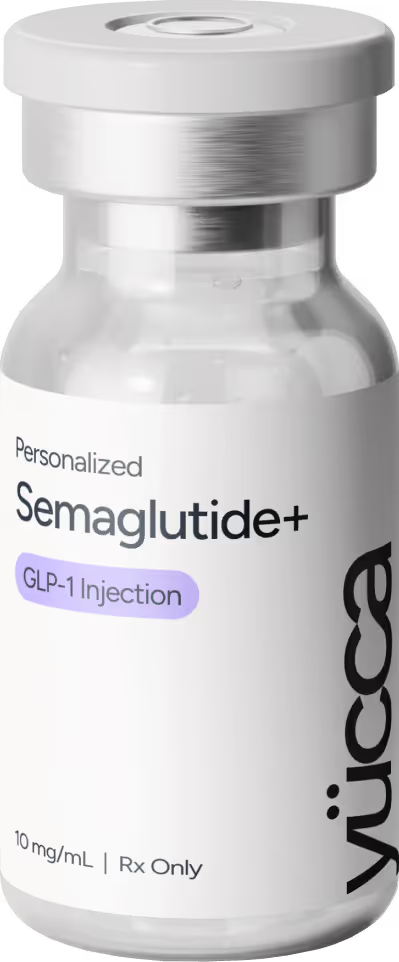
Semaglutide also has several product names and indications. Ozempic is a semaglutide product used in type 2 diabetes contexts. Wegovy is semaglutide used in weight-management and other labeled contexts. Rybelsus is oral semaglutide for type 2 diabetes. A label statement for one product should be read in its product and population context, even when the active ingredient overlaps.
Timing also matters. Some eye concerns come from randomized-trial safety tables, some from postmarketing reports, some from observational studies, and some from regulator signal review. Those source types answer different questions. A randomized trial can describe what happened in a selected population under monitoring. A postmarketing signal can catch rare or delayed events but often needs further analysis. A label update can tell clinicians what to watch for, but it still needs population context.
The older GLP-1 thyroid warning guide is a useful analogy. Boxed warning language, rodent signals, contraindications, human observational findings, and screening claims are not interchangeable. Eye-risk claims need the same discipline: identify the condition, product, population, source type, and what the source actually measured.
Diabetic Retinopathy Warning: What It Does And Does Not Say
Semaglutide labeling includes diabetic retinopathy complications language for patients with type 2 diabetes and a history of diabetic retinopathy. The warning is not based on a simple "semaglutide harms eyes" rule. It is rooted in diabetes trial context, especially the cardiovascular-outcomes setting in which diabetic retinopathy complications were observed more often with semaglutide than placebo.
The SUSTAIN-6 cardiovascular-outcomes trial is important here because it studied patients with type 2 diabetes at high cardiovascular risk. That trial showed cardiovascular benefit signals, but it also reported the retinopathy complication imbalance that became part of semaglutide safety interpretation. The useful reading is not that diabetes eye disease makes semaglutide impossible. The useful reading is that people with diabetic retinopathy need product-label-aware monitoring and clinical context.
Rapid improvement in glucose control has long been discussed as a potential retinopathy-worsening context in diabetes care. That does not prove the entire signal is explained by glucose change, and it does not remove the need for monitoring. It means the mechanism discussion should stay close to the diabetes population where the signal was seen.
A practical reading is that eye history belongs in the baseline discussion for patients with diabetes. Existing retinopathy, recent eye exams, A1C level, planned glucose lowering, insulin use, and symptoms all matter more than a generic social-media rule. Label language supports monitoring. It does not turn a medical decision into a yes-or-no internet checklist.
The warning also should not be exported to every GLP-1 conversation without context. A person using an approved semaglutide product for obesity without diabetes is in a different baseline-risk category from a person with long-standing type 2 diabetes, insulin use, high A1C, and existing retinopathy. Search summaries often flatten those differences.
NAION Signal: What The Regulator Review Means
NAION is a different eye condition. It involves ischemic injury to the optic nerve rather than diabetic retinal disease. Symptoms can include sudden vision loss, often without pain, and urgent medical evaluation is important because many eye and neurologic conditions can present with acute visual changes.
In June 2025, the European Medicines Agency's safety committee concluded that NAION should be listed as a very rare side effect for semaglutide medicines including Ozempic, Rybelsus, and Wegovy. The same announcement advised that patients who experience sudden loss of vision or rapidly worsening eyesight during treatment should contact a doctor without delay and that semaglutide should be stopped if NAION is confirmed.
That regulator language is stronger than a forum anecdote, but it still needs careful reading. "Very rare side effect" is not the same as a common outcome. It is also not the same as saying every report proves direct causation in every patient. Regulators weigh reports, studies, plausibility, product exposure, and alternative explanations to decide whether product information should change.
Observational eye-safety studies are useful because NAION is uncommon enough that ordinary weight-loss trials may not be sized to estimate the risk precisely. They also have limits. People prescribed semaglutide may differ from people not prescribed it by diabetes severity, obesity, sleep apnea, vascular risk, eye history, and health-system contact. Those differences can be adjusted for, but not perfectly erased.
The NAION signal also should not be used to dismiss semaglutide's established evidence in labeled populations. The same active ingredient has PubMed-indexed randomized trial evidence for weight-management, diabetes, cardiovascular-risk, and kidney-disease contexts. Safety signals are part of that evidence picture. They do not erase it, and they do not authorize exaggerated fear marketing either.
What About Tirzepatide And Other GLP-1 Drugs?
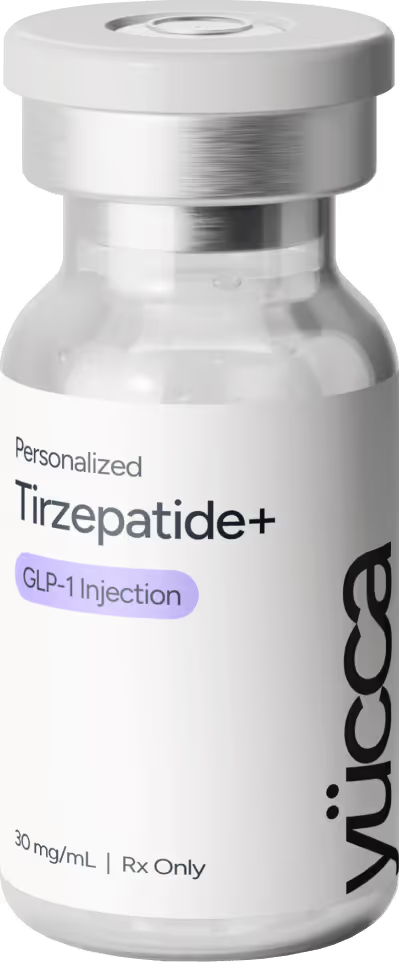
The search result often broadens from Ozempic to all GLP-1 or incretin drugs. That shortcut can be misleading. Tirzepatide activates GIP and GLP-1 receptors, while semaglutide is a GLP-1 receptor agonist. They share some class-level concerns, but they have separate labels, trial programs, doses, approved indications, and adverse-event tables.
A semaglutide-specific regulator conclusion should not automatically be assigned to retatrutide, cagrilintide, or every investigational incretin and amylin-pathway drug. The broader GLP-1, GIP, glucagon, and amylin comparison explains why receptor family language is not enough.
The same caution applies to compounded and unapproved products. FDA has repeatedly warned that unapproved GLP-1 products can create dosing, quality, source, salt-form, storage, and counterfeit risks. A seller page that uses an active-ingredient name does not inherit the safety review, label language, or manufacturing controls of a regulated product.
How To Read Vision-Loss Claims
First, identify the eye condition. Diabetic retinopathy, NAION, retinal vein occlusion, migraine aura, cataract, dry eye, hypoglycemia-related visual symptoms, and neurologic emergencies are not the same thing. A post that says "vision loss" without naming the diagnosis is not specific enough.
Second, identify the product and population. Ozempic in type 2 diabetes, Wegovy in obesity, oral semaglutide, tirzepatide, and unapproved research-market products sit in different evidence categories. Diabetes duration, baseline retinopathy, glucose trajectory, blood pressure, sleep apnea, vascular disease, and medication history can all change interpretation.
Third, separate medical decisions from calculator math. The reconstitution calculator can help readers understand concentration arithmetic. It cannot determine whether a visual symptom is NAION, whether diabetic retinopathy monitoring is adequate, or whether a product has the same identity as an approved semaglutide medicine.
Fourth, use official sources for warning language. Labels and regulator communications are stronger than social media screenshots. PubMed-indexed papers are stronger than marketing pages. Forum discussion can reveal what people are asking, but it should not be treated as proof of causality.
Red-flag phrasing includes claims that Ozempic "always" causes blindness, that NAION is "just diabetic retinopathy," that eye warnings are "fake," or that switching to an unapproved version removes risk. Those statements collapse a complicated safety question into a slogan. Better claims name the diagnosis, product, population, source, and uncertainty.
The careful summary is this: semaglutide eye-risk claims deserve attention, but they need exact language. Diabetic retinopathy warning language is most relevant to diabetes populations with retinopathy history. NAION is a separate very rare safety signal reviewed by European regulators. Neither topic validates broad blindness claims, casual product comparisons, or unapproved-product marketing.
References
- Ozempic (semaglutide) prescribing information, U.S. Food and Drug Administration.
- Wegovy (semaglutide) prescribing information, U.S. Food and Drug Administration.
- PRAC concludes eye condition NAION is a very rare side effect of semaglutide medicines Ozempic, Rybelsus and Wegovy, European Medicines Agency.
- Risk of Nonarteritic Anterior Ischemic Optic Neuropathy in Patients Prescribed Semaglutide, JAMA Ophthalmology.
- Semaglutide and Cardiovascular Outcomes in Patients with Type 2 Diabetes, New England Journal of Medicine / PubMed.
- Once-Weekly Semaglutide in Adults with Overweight or Obesity, New England Journal of Medicine / PubMed.
- Safety of Semaglutide, Frontiers in Endocrinology / PubMed.
- Effects of Semaglutide on Chronic Kidney Disease in Patients with Type 2 Diabetes, New England Journal of Medicine / PubMed.
- Tirzepatide Once Weekly for the Treatment of Obesity, New England Journal of Medicine / PubMed.
- FDA Concerns with Unapproved GLP-1 Drugs Used for Weight Loss, U.S. Food and Drug Administration.
Disclaimer
This page is educational and is not medical advice. It does not diagnose eye symptoms, provide prescribing guidance, recommend starting or stopping semaglutide, tirzepatide, or other products, or provide individualized diabetes, obesity, ophthalmology, or emergency-care guidance. Sudden vision loss, rapidly worsening vision, eye pain, neurologic symptoms, or severe illness needs prompt evaluation by qualified healthcare professionals using current official sources.
Next steps
Continue with the closest guide, peptide profile, or research tool.