Tirzepatide OSA evidence
Zepbound for Sleep Apnea: Tirzepatide OSA Evidence and Label Limits
A source-backed guide to Zepbound for obstructive sleep apnea, tirzepatide SURMOUNT-OSA evidence, PAP context, side effects, and label boundaries.

Zepbound became a sleep-apnea search topic after FDA approved tirzepatide for moderate to severe obstructive sleep apnea in adults with obesity on December 20, 2024. The approval matters because it moved a metabolic peptide-based medicine into a sleep-medicine indication, but it should be read carefully. It is not a label for every sleep problem, every GLP-1 drug, or every product sold under the tirzepatide name.
The evidence question is specific: what did SURMOUNT-OSA show in adults with obesity and moderate to severe obstructive sleep apnea, and what does the Zepbound label actually cover? That is different from broad tirzepatide versus semaglutide comparisons, from GLP-1 maintenance questions, and from research-market claims about peptides and sleep.
Peptides Defined covers tirzepatide as a regulated GIP and GLP-1 receptor agonist medicine, while semaglutide has a separate product and trial history. The sleep-apnea indication belongs to Zepbound. That product-specific framing keeps the article grounded and avoids class-wide overclaims.
Evidence Snapshot
| Common claim | Evidence picture | Boundary |
|---|---|---|
| Zepbound is approved for all sleep apnea. | FDA approved Zepbound for moderate to severe obstructive sleep apnea in adults with obesity, alongside reduced calorie intake and increased physical activity. | That does not cover mild OSA, central sleep apnea, snoring without diagnosis, pediatric OSA, or adults without obesity. |
| Tirzepatide replaces PAP therapy. | SURMOUNT-OSA included one trial in participants not using PAP and one in participants using PAP at baseline. | PAP decisions require objective testing, follow-up, and clinician judgment. A medication label does not erase sleep-medicine management. |
| The apnea result proves an airway-specific drug effect. | Trial reports show improvements in AHI, body weight, hypoxic burden, blood pressure, and inflammatory markers. | Weight reduction appears central to the evidence picture; direct airway effects should not be assumed without matching data. |
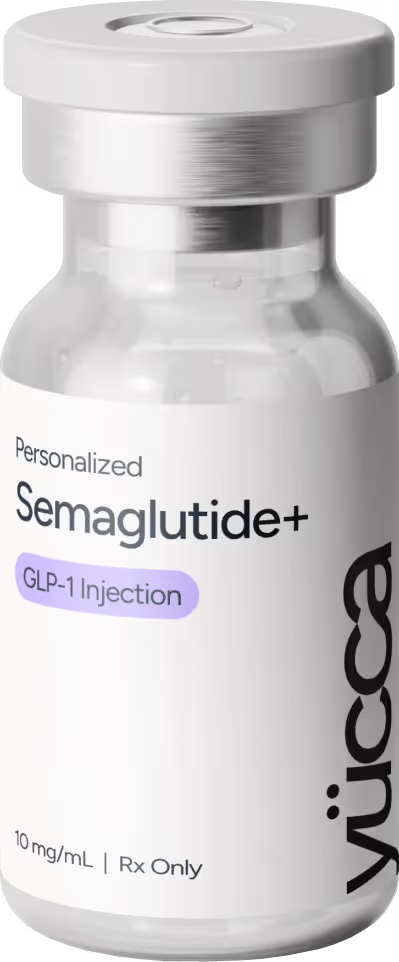
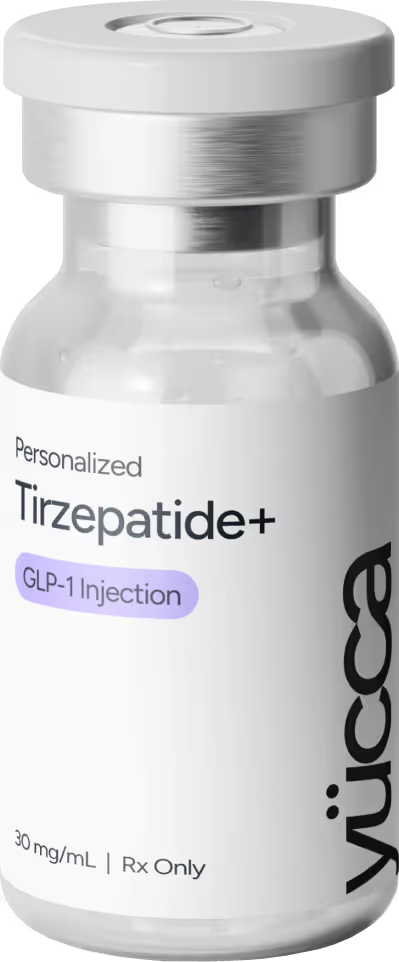
| Any tirzepatide product has the same OSA evidence. | The approval and trial evidence belong to FDA-reviewed Zepbound, not research powders, compounded products, or informal products. | Identity, formulation, device, storage, concentration, and lawful status are product-specific. |
| Semaglutide or any GLP-1 has the same sleep-apnea label. | Liraglutide has older OSA trial evidence, and semaglutide has obesity evidence, but Zepbound is the product with the FDA OSA indication. | Class-adjacent weight-loss evidence should not be treated as a product-specific OSA approval. |
What FDA Approved
FDA's December 2024 approval notice says Zepbound is approved for treatment of moderate to severe obstructive sleep apnea in adults with obesity, in combination with reduced calorie intake and increased physical activity. The obesity requirement is not a footnote. It is part of the labeled population and part of the biological rationale behind the trial program.
Obstructive sleep apnea is diagnosed through objective sleep testing, commonly using the apnea-hypopnea index, or AHI. AHI counts apneas and hypopneas per hour of sleep. SURMOUNT-OSA used AHI as the primary endpoint, which gives the indication a sleep-study anchor rather than relying only on weight, snoring, or daytime fatigue.
The label should also be read as a Zepbound label, not a generic tirzepatide statement. Mounjaro and Zepbound share tirzepatide as the active ingredient, but their labels, indications, dose contexts, devices, and patient populations are not identical. Research powders, compounded products, or informal products marketed as tirzepatide do not inherit an FDA-reviewed OSA indication.
The approval also does not remove standard sleep-apnea care. PAP therapy, oral appliances, weight management, positional strategies, surgery, and monitoring can all be part of clinician-directed management. Zepbound adds a medication option for a defined population. It does not turn self-diagnosis, device abandonment, or product substitution into evidence-based care.
What SURMOUNT-OSA Showed
SURMOUNT-OSA was published as two 52-week, randomized, double-blind, placebo-controlled Phase 3 trials. Adults with obesity and moderate to severe OSA were assigned to tirzepatide or placebo. Trial 1 enrolled participants who were not receiving positive airway pressure therapy at baseline. Trial 2 enrolled participants who were receiving PAP therapy at baseline.
That split is clinically useful. It means the evidence was not built from one mixed group where PAP status was a background detail. It examined a non-PAP setting and a PAP-treated setting separately, with the same broad question: whether tirzepatide reduced AHI compared with placebo over 52 weeks.
The trial report states that tirzepatide reduced AHI, body weight, hypoxic burden, high-sensitivity C-reactive protein concentration, and systolic blood pressure, and improved sleep-related patient-reported outcomes. Those outcomes make the evidence stronger than a weight-only story, but they still need careful interpretation. Reduced AHI in a trial is not the same as a reader deciding that medication alone is the right sleep-apnea plan.
AHI is also only one way to summarize sleep-disordered breathing. Hypoxic burden, oxygen desaturation, arousals, sleepiness, blood pressure, PAP adherence, and quality of life can tell different parts of the story. A claim that mentions only "sleep apnea got better" is not specific enough. A stronger claim names the tested population, the endpoint, the time point, and whether PAP was part of background care.
Time-course and secondary-outcome analyses add detail. They help readers understand how sleep-disordered breathing changed over the treatment period and how patient-reported outcomes moved. They also reinforce a central point: OSA in adults with obesity is connected to weight, upper-airway mechanics, cardiometabolic risk, inflammation, and sleep quality. A single headline cannot carry all of those dimensions.
Older GLP-1 evidence is relevant but not equivalent. The SCALE Sleep Apnea randomized trial studied liraglutide 3.0 mg in adults with obesity and moderate or severe OSA who were unwilling or unable to use continuous positive airway pressure therapy. That supports the history of incretin-based obesity treatment being studied in OSA, but Zepbound's current label is tied to tirzepatide and SURMOUNT-OSA.
This is why claims that "GLP-1 drugs treat sleep apnea" are too broad. Tirzepatide has product-specific OSA evidence and label status. Semaglutide has extensive obesity, cardiometabolic, kidney, and MASH evidence in other contexts, but it does not automatically carry Zepbound's OSA indication.
Why PAP Context Still Matters
PAP therapy remains a major standard sleep-apnea treatment. AASM guidance emphasizes diagnosis through objective testing and follow-up to monitor efficacy and use. That remains true even after a medication approval, because untreated or undertreated OSA can have cardiometabolic and neurocognitive consequences.
The practical mistake is to treat Zepbound as a simple PAP replacement. SURMOUNT-OSA does not support that shortcut. It included both participants not using PAP and participants using PAP, and the interpretation depends on trial design, baseline severity, adherence, body-weight change, tolerability, and clinical monitoring.
A reader using PAP should not stop therapy because of an online post about tirzepatide. A reader not using PAP should not assume medication is enough without a diagnosis and follow-up. A reader with central sleep apnea, complex sleep apnea, severe lung disease, opioid-related breathing disorders, or other sleep-breathing patterns should be especially cautious about applying an obstructive-sleep-apnea label too broadly.
This also matters for people whose symptoms improve before their sleep-study metrics are rechecked. Less snoring, lower weight, or better daytime energy can be encouraging, but those signals do not confirm that airway obstruction has resolved to a clinically acceptable range. Follow-up testing and device data are part of why sleep-medicine claims should stay more precise than ordinary weight-loss testimonials.
The reconstitution calculator has no role in sleep-apnea management beyond general measurement literacy. It cannot diagnose OSA, interpret AHI, verify a tirzepatide product, adjust a PAP device, or convert a research product into Zepbound.
Side Effects And Label Boundaries
Tirzepatide's OSA label context does not remove GLP-1 and GIP safety considerations. Zepbound labeling includes warnings for thyroid C-cell tumor risk language, acute pancreatitis, acute gallbladder disease, hypoglycemia risk with insulin or insulin secretagogues, acute kidney injury related to volume depletion, severe gastrointestinal adverse reactions, hypersensitivity reactions, diabetic retinopathy complications in patients with type 2 diabetes, and pulmonary aspiration during anesthesia or deep sedation.
Gastrointestinal adverse events were the most frequently reported adverse events in SURMOUNT-OSA and are a practical issue in real use. Nausea, vomiting, diarrhea, constipation, abdominal pain, and reduced intake can matter for hydration, sleep quality, diabetes medication adjustment, and tolerance of dose escalation.
Product quality is another boundary. FDA has warned about unapproved GLP-1 products, including semaglutide and tirzepatide products marketed for weight loss. Those concerns apply to identity, quality, storage, dosing errors, and adverse events. A new OSA indication may increase interest in non-approved products, but it does not make those products equivalent to Zepbound.
For broader safety context, read the GLP-1 side effects and safety signals guide and the peptide injection-site reactions and product-quality guide. For product status categories, use approved vs investigational vs compounded vs research peptides.
How To Evaluate Zepbound OSA Claims
Start with the diagnosis. Is the claim about moderate to severe obstructive sleep apnea confirmed by objective testing, or is it about snoring, poor sleep, fatigue, wearable-device data, or self-suspected apnea? The Zepbound label and SURMOUNT-OSA evidence belong to diagnosed OSA, not every sleep complaint.
Next, check the population. The FDA indication is for adults with obesity. A claim about adults without obesity, adolescents, mild OSA, central apnea, or people with complex pulmonary disease is outside the core label unless it cites separate evidence.
Then check the comparator and background care. Was the person using PAP? Was PAP adherence monitored? Was the outcome AHI, hypoxic burden, blood pressure, weight, daytime sleepiness, or quality of life? A medication claim that does not name the endpoint is weaker than it looks.
Finally, check the product. Zepbound is an FDA-approved tirzepatide product. Compounded tirzepatide, research tirzepatide, imported products, and unverified vials should not be described as having the same OSA evidence. The GLP-1 compounding rules guide explains why the ingredient name is not enough.
The restrained takeaway is that Zepbound has strong human randomized evidence and FDA labeling for a defined OSA population: adults with obesity and moderate to severe obstructive sleep apnea. The evidence does not justify class-wide claims, PAP shortcuts, self-diagnosis, or research-market product substitution.
References
- FDA Approves First Medication for Obstructive Sleep Apnea, U.S. Food and Drug Administration.
- Zepbound prescribing information, 2026 label, U.S. Food and Drug Administration.
- Tirzepatide for the Treatment of Obstructive Sleep Apnea and Obesity, New England Journal of Medicine / PubMed.
- Tirzepatide for the treatment of obstructive sleep apnea: Rationale, design, and sample baseline characteristics of the SURMOUNT-OSA phase 3 trial, PubMed.
- Tirzepatide for sleep-disordered breathing in SURMOUNT-OSA: Time course and association with body weight, PubMed.
- Effect of tirzepatide treatment on patient-reported outcomes among SURMOUNT-OSA participants with obstructive sleep apnea and obesity, PubMed.
- Effect of liraglutide 3.0 mg in individuals with obesity and moderate or severe obstructive sleep apnea: the SCALE Sleep Apnea randomized clinical trial, PubMed.
- Treatment of Adult Obstructive Sleep Apnea with Positive Airway Pressure: An American Academy of Sleep Medicine Clinical Practice Guideline, PubMed.
- Tirzepatide Once Weekly for the Treatment of Obesity, New England Journal of Medicine / PubMed.
- FDA Concerns with Unapproved GLP-1 Drugs Used for Weight Loss, U.S. Food and Drug Administration.
Disclaimer
This page is educational and is not medical advice. It does not provide prescribing, dosing, switching, compounding, reconstitution, sourcing, sleep-apnea diagnosis, PAP adjustment, weight-loss treatment, diabetes treatment, or individualized guidance for Zepbound, Mounjaro, tirzepatide, semaglutide, or related products. Sleep-apnea and medication decisions should be made with qualified healthcare professionals using current regulator-reviewed labels, objective sleep testing, and clinical context.
Next steps
Continue with the closest guide, peptide profile, or research tool.