Semaglutide cardiovascular evidence
Wegovy Heart Attack and Stroke Evidence: SELECT, Label Limits, and Safety
A source-backed guide to Wegovy cardiovascular-risk reduction, SELECT trial evidence, semaglutide label boundaries, safety warnings, and claim limits.

Wegovy became more than a weight-management search topic when FDA approved a cardiovascular-risk indication for semaglutide in March 2024. The current label includes use to reduce major adverse cardiovascular events in adults with established cardiovascular disease and either obesity or overweight. That is a meaningful label change, but it is also narrower than many online summaries make it sound.
The core evidence comes from SELECT, a large randomized outcomes trial of weekly semaglutide 2.4 mg in adults with cardiovascular disease, overweight or obesity, and no history of diabetes. That population is different from people using semaglutide only for weight loss, from diabetes populations covered by Ozempic evidence, and from people comparing tirzepatide or other incretin drugs.
A careful reading matters because "heart protection" can be too vague. The stronger claim is more specific: SELECT showed fewer cardiovascular death, nonfatal myocardial infarction, or nonfatal stroke events in a defined high-risk population. It did not turn every semaglutide product into a general heart-disease prevention product.
Evidence Snapshot
| Common claim | Evidence picture | Boundary |
|---|---|---|
| Wegovy is approved for heart attack and stroke risk reduction in everyone. | FDA labeling covers adults with established cardiovascular disease and either obesity or overweight, alongside reduced calorie intake and increased physical activity. | The label is not a general prevention indication for adults without established cardiovascular disease. |
| SELECT proves the benefit is only weight loss. | SELECT tested semaglutide 2.4 mg versus placebo in adults with cardiovascular disease, overweight or obesity, and no diabetes. | The trial showed fewer major cardiovascular events, but the exact mechanism of risk reduction remains a separate question. |
| Ozempic and Wegovy have the same cardiovascular use. | Both contain semaglutide, and semaglutide has cardiovascular-outcome evidence in diabetes and obesity contexts. | Product labels, indications, dose contexts, and populations are not interchangeable. |
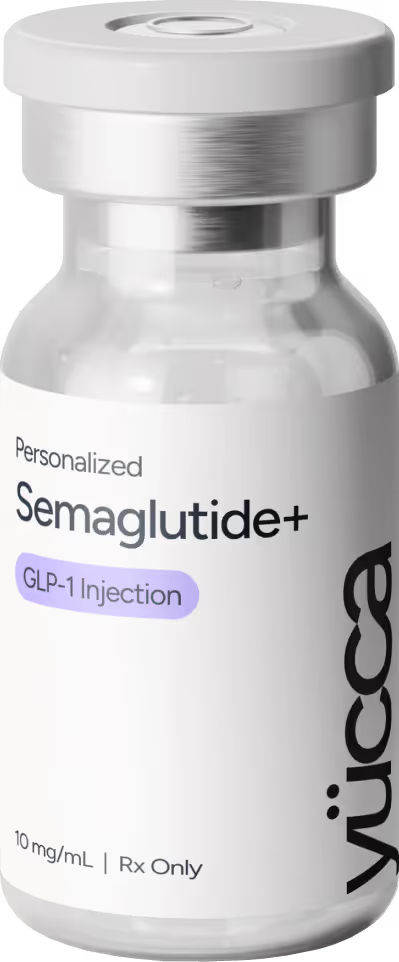
| Any semaglutide product has SELECT evidence. | SELECT studied a defined semaglutide 2.4 mg clinical-trial product and informed Wegovy labeling. | Compounded, counterfeit, research-labeled, or non-FDA-approved products do not inherit FDA-reviewed evidence. |
| The cardiovascular label removes ordinary GLP-1 safety concerns. | Wegovy labeling still includes warnings for pancreatitis, gallbladder disease, kidney injury due to volume depletion, severe gastrointestinal reactions, retinopathy monitoring in diabetes, and other risks. | A cardiovascular benefit claim still has to be read with the safety and product-quality context. |
What The Wegovy Label Says
The current Wegovy label lists semaglutide as a GLP-1 receptor agonist and includes injection and tablet presentations. For cardiovascular-risk reduction, the label covers adults with established cardiovascular disease and either obesity or overweight. It names major adverse cardiovascular events as cardiovascular death, nonfatal myocardial infarction, or nonfatal stroke.
That wording is important. Established cardiovascular disease is not the same as family history alone, a wearable alert, a high cholesterol lab, or a general desire to protect the heart. Obesity or overweight is also part of the labeled population. The label does not say that everyone using semaglutide gets a cardiovascular indication.
The label also keeps standard product boundaries. Wegovy should not be coadministered with other semaglutide-containing products or other GLP-1 receptor agonists. That matters for readers who see stack claims, duplicate-product claims, or attempts to combine semaglutide products with research-market incretins.
FDA's March 2024 announcement described Wegovy as the first weight-loss medication approved to help prevent life-threatening cardiovascular events in adults with cardiovascular disease and either obesity or overweight. That milestone explains the search demand, but the label remains the source that defines who and what the indication covers.
What SELECT Actually Tested
SELECT enrolled 17,604 adults who were 45 years of age or older, had preexisting cardiovascular disease, had a body mass index of 27 or greater, and had no history of diabetes. Participants were randomized to weekly subcutaneous semaglutide 2.4 mg or placebo. The primary outcome was a time-to-first-event composite of cardiovascular death, nonfatal myocardial infarction, or nonfatal stroke.
The headline result was a hazard ratio of 0.80 for the primary cardiovascular endpoint. In plain terms, the trial reported fewer first major cardiovascular events in the semaglutide group than in the placebo group over a mean follow-up of about 40 months. The absolute event counts were 569 of 8,803 participants in the semaglutide group and 701 of 8,801 participants in the placebo group.
SELECT is stronger than a biomarker study because it measured clinical events. It is also stronger than a weight-only study because the outcome was not just body weight, waist circumference, or cardiometabolic labs. Still, it remains a trial in a defined population. Results from adults with established cardiovascular disease and overweight or obesity do not automatically apply to younger low-risk adults, people without cardiovascular disease, or people using non-approved products.
The discontinuation data also deserve attention. SELECT reported more adverse events leading to permanent discontinuation of trial product in the semaglutide group than in the placebo group. That does not erase the cardiovascular result, but it prevents a one-sided reading. Benefit, tolerability, adherence, contraindications, and warnings are all part of the evidence picture.
How This Differs From Diabetes Cardiovascular Evidence
Semaglutide had cardiovascular-outcome evidence before SELECT. SUSTAIN 6 studied injectable semaglutide in people with type 2 diabetes at high cardiovascular risk. PIONEER 6 studied oral semaglutide in high-risk type 2 diabetes. Those trials are relevant because they show that semaglutide has been studied across cardiovascular-outcome settings.
But diabetes cardiovascular-outcome trials answer a different question. They were designed around safety and outcomes in type 2 diabetes populations, not adults without diabetes who have cardiovascular disease and overweight or obesity. SELECT is the key trial for the Wegovy cardiovascular-risk indication in the obesity or overweight population without diabetes.
This distinction helps avoid product confusion. Ozempic, Rybelsus, and Wegovy all involve semaglutide, but they do not have identical labels, dose contexts, or use cases. Peptides Defined covers Ozempic kidney-disease evidence separately for the same reason: a semaglutide result needs its product, population, and endpoint.
It also helps with comparisons to tirzepatide. Zepbound has its own approved indications and human evidence, including tirzepatide HFpEF evidence and Zepbound obstructive sleep apnea evidence. Those are not the same as SELECT, even though all of these topics sit inside the broader incretin-drug discussion.
What The Cardiovascular Claim Does Not Show
The SELECT result should not be rewritten as "semaglutide prevents heart attacks in everyone." It was not a primary-prevention trial in low-risk adults. It was not a trial of compounded semaglutide, research semaglutide, unapproved oral drops, or multi-ingredient blends. It was not designed to show that every GLP-1 receptor agonist has the same cardiovascular label.
It also should not be reduced to a single mechanism claim. Weight reduction likely contributes to cardiometabolic benefit, but SELECT does not prove that all of the cardiovascular effect is mediated only by weight loss. GLP-1 biology may affect inflammation, blood pressure, glycemia, endothelial function, and other pathways, but mechanistic hypotheses are not the same as a label indication.
The most precise wording is specific. Human evidence indicates that weekly semaglutide 2.4 mg reduced a composite of cardiovascular death, nonfatal myocardial infarction, or nonfatal stroke in adults with established cardiovascular disease and overweight or obesity in SELECT. That is a strong statement because it is also bounded.
For adjacent context, the retatrutide, tirzepatide, and semaglutide comparison explains why receptor targets and trial stages cannot be collapsed into one class claim. The incretin and amylin comparison gives broader receptor background.
Safety And Product-Quality Boundaries
A cardiovascular-risk indication does not remove Wegovy's safety warnings. The current label includes warnings for acute pancreatitis, acute gallbladder disease, hypoglycemia risk with insulin or insulin secretagogues, acute kidney injury due to volume depletion, severe gastrointestinal adverse reactions, hypersensitivity reactions, diabetic retinopathy complications in patients with type 2 diabetes, heart-rate increase, and pulmonary aspiration during anesthesia or deep sedation.
The GLP-1 side effects guide covers those signals as a broad safety-literacy topic. The key point here is that cardiovascular evidence and adverse-event evidence are read together. A medication can have a favorable outcome in a high-risk trial and still require individualized medical screening, monitoring, and label-aware use.
Product quality is another boundary. FDA has warned about non-FDA-approved GLP-1 products, including dosing errors, salt forms, counterfeit products, storage concerns, and research-labeled products sold for human use. SELECT cannot validate those products because it did not test them. The compounded semaglutide and tirzepatide rules guide explains why the active ingredient name is not enough.
The reconstitution calculator can help readers understand concentration math. It cannot verify semaglutide identity, create a Wegovy equivalent, define a cardiovascular indication, or translate SELECT into a self-directed protocol.
The practical takeaway is restrained: Wegovy has FDA-reviewed cardiovascular-risk labeling supported by SELECT for a defined high-risk population. That is an important evidence milestone. It is not a blanket heart-health claim for all GLP-1 products, all semaglutide products, or all people interested in weight loss.
References
- Wegovy (semaglutide) prescribing information, 2026 label, U.S. Food and Drug Administration.
- FDA Approves First Treatment to Reduce Risk of Serious Heart Problems Specifically in Adults with Obesity or Overweight, U.S. Food and Drug Administration.
- Semaglutide and Cardiovascular Outcomes in Obesity without Diabetes, New England Journal of Medicine / PubMed.
- Semaglutide and Cardiovascular Outcomes in Patients with Type 2 Diabetes, New England Journal of Medicine / PubMed.
- Oral Semaglutide and Cardiovascular Outcomes in Patients with Type 2 Diabetes, New England Journal of Medicine / PubMed.
- Cardiovascular, mortality, and kidney outcomes with GLP-1 receptor agonists in patients with type 2 diabetes, The Lancet Diabetes & Endocrinology / PubMed.
- Once-Weekly Semaglutide in Adults with Overweight or Obesity, New England Journal of Medicine / PubMed.
- FDA Concerns with Unapproved GLP-1 Drugs Used for Weight Loss, U.S. Food and Drug Administration.
Disclaimer
This page is educational and is not medical advice. It does not provide prescribing, dosing, switching, compounding, reconstitution, cardiovascular treatment, weight-loss treatment, diabetes treatment, or individualized guidance for Wegovy, Ozempic, Rybelsus, semaglutide, tirzepatide, or related products. Medication decisions should be made with qualified healthcare professionals using current regulator-reviewed labels and personal medical history.
Next steps
Continue with the closest guide, peptide profile, or research tool.