GH-axis mechanisms
CJC-1295 and Ipamorelin Stack: Synergy Rationale and Evidence Limits
A source-backed look at the CJC-1295 and ipamorelin stack: GHRH plus GHRP synergy rationale, human biomarker data, missing clinical evidence, and FDA limits.

"CJC-1295 and ipamorelin" is one of the most repeated peptide pairings online, usually presented as a finished protocol with confident promises about fat loss, lean mass, recovery, and sleep. The pairing does have a real mechanistic logic, and that logic is worth understanding clearly. But a sound rationale is not the same as a validated product, and most stack claims drift well past what the published evidence supports.
This guide explains why the two molecules are combined, what the human synergy literature actually studied, and where the evidence stops. For single-molecule basics, start with the CJC-1295 peptide guide and the ipamorelin peptide guide. For the naming and side-effect questions specific to CJC-1295, see the DAC vs no-DAC review.
Evidence Snapshot
| Common claim | Evidence picture | Boundary |
|---|---|---|
| CJC-1295 and ipamorelin act on different receptors. | CJC-1295 is described as a long-acting GHRH analog, while ipamorelin is a selective GHRP-receptor (ghrelin-receptor) agonist. | Different receptor targets explain a mechanistic rationale; they do not prove a specific consumer outcome. |
| GHRH plus a GHRP releases more GH together than alone. | Controlled human studies of GHRH combined with a GH-releasing peptide reported synergistic, not merely additive, GH release. | Those studies used GHRP-6 and native GHRH, not the modern CJC-1295 plus ipamorelin product pairing. |
| The CJC-1295 plus ipamorelin stack is clinically validated. | Each molecule has separate human pharmacology research around GH-axis signaling. | No large clinical trial establishes the combined product for fat loss, muscle, recovery, sleep, or anti-aging. |
| Ipamorelin is "cleaner" than older secretagogues. | The original characterization reported GH release without significant ACTH, cortisol, or prolactin elevation. | Selectivity in early studies is not the same as proven long-term safety in a compounded stack. |
| Higher GH and IGF-1 means better real-world results. | Biomarker increases are measurable endpoints in short studies. | Biomarker movement does not establish physique, performance, healing, or longevity outcomes. |
Why The Two Are Combined
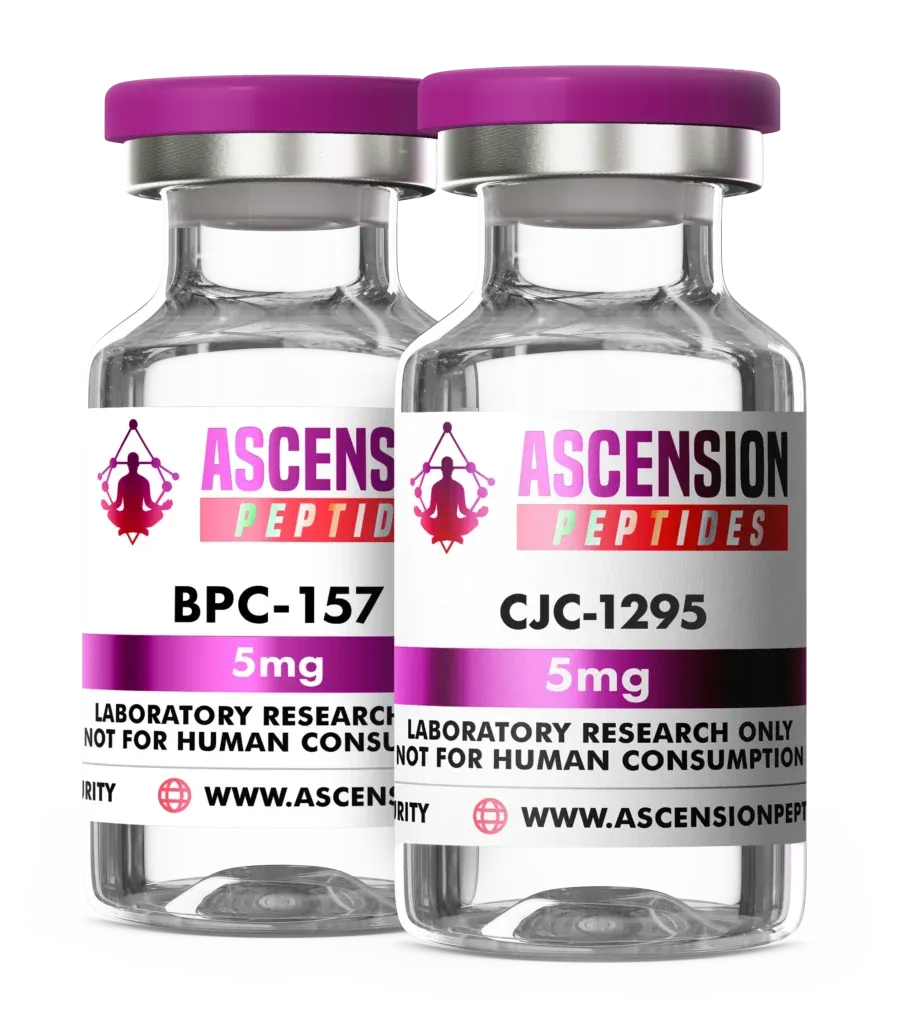
The pairing reflects two different ways of nudging the same growth-hormone axis. CJC-1295 is described in its core human studies as a long-acting analog of growth hormone-releasing hormone (GHRH). It works on the GHRH receptor side of the pituitary, the pathway that the body's own hypothalamic GHRH uses to encourage GH release.
Ipamorelin is a different kind of molecule. It is a pentapeptide that the original 1998 characterization called the first selective growth hormone secretagogue. It acts on the GH-releasing peptide (GHRP) receptor, now understood as the ghrelin receptor, which is a separate pathway from GHRH. In that early work, ipamorelin released GH without significantly raising ACTH, cortisol, or prolactin, which is the basis for its "selective" or "clean" framing.
The stacking idea is simple to state: combine a GHRH-side signal with a GHRP-side signal so two complementary mechanisms push at once. Marketers often describe this as "more physiologic" than injecting recombinant growth hormone directly, because the pituitary still controls release. That framing has a kernel of mechanistic truth, but it is also where claims tend to outrun the data.
CJC-1295 also sits in a broader GHRH-pathway family alongside sermorelin and tesamorelin. The growth-hormone peptide comparison covers how those molecules differ at the class level; this page focuses specifically on the CJC-1295 plus ipamorelin combination.
What The Synergy Evidence Actually Shows
The strongest support for the "two pathways together" idea comes from older controlled human research on GHRH combined with a GH-releasing peptide. In normal men, a GH-releasing peptide stimulated GH release on its own and acted synergistically with GHRH, producing a combined response larger than either agent alone. Related work proposed that GHRP releases GH through a dual site of action on the hypothalamus and pituitary that complements GHRH.
That biology is the real scientific root of the modern stack rationale. Two independent receptor mechanisms can reinforce each other, so a GHRH-type signal and a GHRP-type signal together can release more GH than a single agent.
The important caveat is in the details. Those synergy studies typically used GHRP-6 and native GHRH under acute, controlled laboratory conditions, with GH and IGF-1 as the measured endpoints. They were not studies of CJC-1295 plus ipamorelin as a product, were not long-term, and did not test physique, performance, injury healing, or sleep outcomes. The pathway logic transfers; the specific product validation does not.
CJC-1295 itself has its own small human record. Randomized, placebo-controlled, ascending-dose studies in healthy adults reported sustained GH and IGF-1 increases, and a separate study found that pulsatile GH secretion persisted during continuous CJC-1295 stimulation. Ipamorelin has documented GH-releasing pharmacology in its own right. But two separate single-molecule research stories, plus general GHRH-and-GHRP synergy work, do not equal a clinical trial of the combined consumer protocol.
What The Stack Evidence Is Missing
Everything turns on the gap between a plausible mechanism and a proven product. The combination is usually sold for body recomposition, faster recovery, deeper sleep, and anti-aging. None of those outcomes is established by a large, predefined, controlled human trial of CJC-1295 plus ipamorelin.
Several specific things are absent from the public record. There is no large randomized trial of the exact pairing, no long-term safety follow-up of the combination, no standardized dosing validated by a regulator, and no outcome data showing that the biomarker bump translates into the promised real-world results. The studies that do exist were short, used small and often healthy populations, and measured hormones rather than the goals buyers care about.
This is the same evidence hierarchy described in How to Read a Peptide Study. Human biomarker data and mechanistic synergy work are stronger than cell-only or animal-only evidence, but they sit well below a large patient-centered trial with clinical endpoints and safety monitoring. A confident protocol built on biomarker studies is reading more into the data than the data can carry.
Safety And Regulatory Context
Neither CJC-1295 nor ipamorelin is an FDA-approved consumer medicine in the sources reviewed here. Both appear in FDA compounding materials rather than as approved drugs with regulator-reviewed labeling, dosing, contraindications, and adverse-event tables. FDA has placed certain peptides into bulk-drug-substance categories that raise safety questions, including immunogenicity concerns tied to peptide aggregation and impurities, and has noted limited clinical data for some of these substances.
Compounded drugs are also not FDA-approved, and FDA does not review them for safety, effectiveness, or quality before marketing the way it reviews approved medicines. That matters most for injectable peptides, where sterility, endotoxin status, concentration accuracy, and identity are real risks. A combined stack compounds those uncertainties, because two active ingredients, excipients, and a shared route all have to be correct at once.
Growth-hormone-axis biology is not risk-free either. Pushing GH and IGF-1 raises long-standing questions about glucose handling, fluid retention, carpal-tunnel-type symptoms, joint discomfort, and cancer biology. The broader review of ipamorelin side effects and the CJC-1295 side-effect review both explain why "clean" and "natural pulse" language can obscure these questions rather than answer them. A general review of GH secretagogue safety and efficacy reaches similarly cautious conclusions.
Athletes face an additional rule. WADA's 2026 Prohibited List includes growth hormone-releasing factors, GHRH analogs such as CJC-1295, and GH secretagogues. A research-use label or a stack marketed for "wellness" does not remove anti-doping responsibility.
How To Evaluate Stack Claims
First, separate mechanism from outcome. "Two pathways release more GH" is supported by GHRH-and-GHRP synergy research. "This stack will recomposition your body" is not the same statement and needs direct human outcome evidence.
Second, check whether a source cites the actual combination or borrows single-molecule and GHRP-6 studies. Evidence drifts when a CJC-1295 paper, an ipamorelin paper, and an old synergy paper are stitched together to imply a tested product that was never trialed as a unit.
Third, identify the product category. An investigational compound, an FDA-approved drug, a compounded preparation, and an online research-use vial are different evidence objects. The approved versus investigational peptide guide is the safest framework, and the injection-site reaction guide covers why route and product quality are separate safety questions.
The conservative bottom line: the CJC-1295 plus ipamorelin pairing rests on a real but narrow foundation of GHRH-and-GHRP synergy biology and small single-molecule studies. It is not a clinically validated protocol, it is not FDA-approved, and broad body-composition or anti-aging promises are not supported by the published record.
FAQ
Is the CJC-1295 plus ipamorelin stack proven to work? No. There is mechanistic logic and small single-molecule biomarker data, but no large controlled trial validates the combined product for the outcomes it is usually sold for.
Why combine a GHRH analog with a GHRP? They act on different receptors, and older human studies showed GHRH plus a GH-releasing peptide can release GH synergistically. That rationale is real but was studied with different compounds and short endpoints.
Is the combination FDA-approved? No. Both molecules appear in FDA compounding materials rather than as approved consumer medicines, and compounded products are not FDA-reviewed for safety, effectiveness, or quality before marketing.
Does higher GH and IGF-1 mean better results? Not necessarily. Biomarker increases are measurable, but they do not establish fat loss, muscle gain, recovery, sleep, or longevity outcomes.
References
- Prolonged stimulation of growth hormone (GH) and insulin-like growth factor I secretion by CJC-1295, a long-acting analog of GH-releasing hormone, in healthy adults, Journal of Clinical Endocrinology & Metabolism / PubMed.
- Pulsatile secretion of growth hormone (GH) persists during continuous stimulation by CJC-1295, a long-acting GH-releasing hormone analog, Journal of Clinical Endocrinology & Metabolism / PubMed.
- Growth hormone (GH)-releasing peptide stimulates GH release in normal men and acts synergistically with GH-releasing hormone, Journal of Clinical Endocrinology & Metabolism / PubMed.
- On the actions of the growth hormone-releasing hexapeptide, GHRP, Endocrinology / PubMed.
- Ipamorelin, the first selective growth hormone secretagogue, European Journal of Endocrinology / PubMed.
- The Safety and Efficacy of Growth Hormone Secretagogues, Sexual Medicine Reviews / PubMed.
- Certain Bulk Drug Substances for Use in Compounding that May Present Significant Safety Risks, U.S. Food and Drug Administration.
- Compounding and the FDA: Questions and Answers, U.S. Food and Drug Administration.
- The 2026 Prohibited List, World Anti-Doping Agency.
Disclaimer
This page is educational and is not medical advice. It does not provide dosing, injection, reconstitution, compounding, sourcing, bodybuilding, anti-aging, recovery, sleep, or individualized treatment guidance for CJC-1295, ipamorelin, or any combination of the two. Decisions about growth-hormone pathway drugs, peptide products, adverse symptoms, and medication changes should be made with qualified healthcare professionals using current regulator-reviewed information.
Next steps
Continue with the closest guide, peptide profile, or research tool.