Mechanism explained
How Ipamorelin Works: The Ghrelin Receptor and Selective GH Secretagogue Mechanism
A plain-English guide to how ipamorelin works: GHS-R1a ghrelin-receptor binding, what "selective" GH secretagogue means, the GHRH contrast, and why mechanism is not outcome.
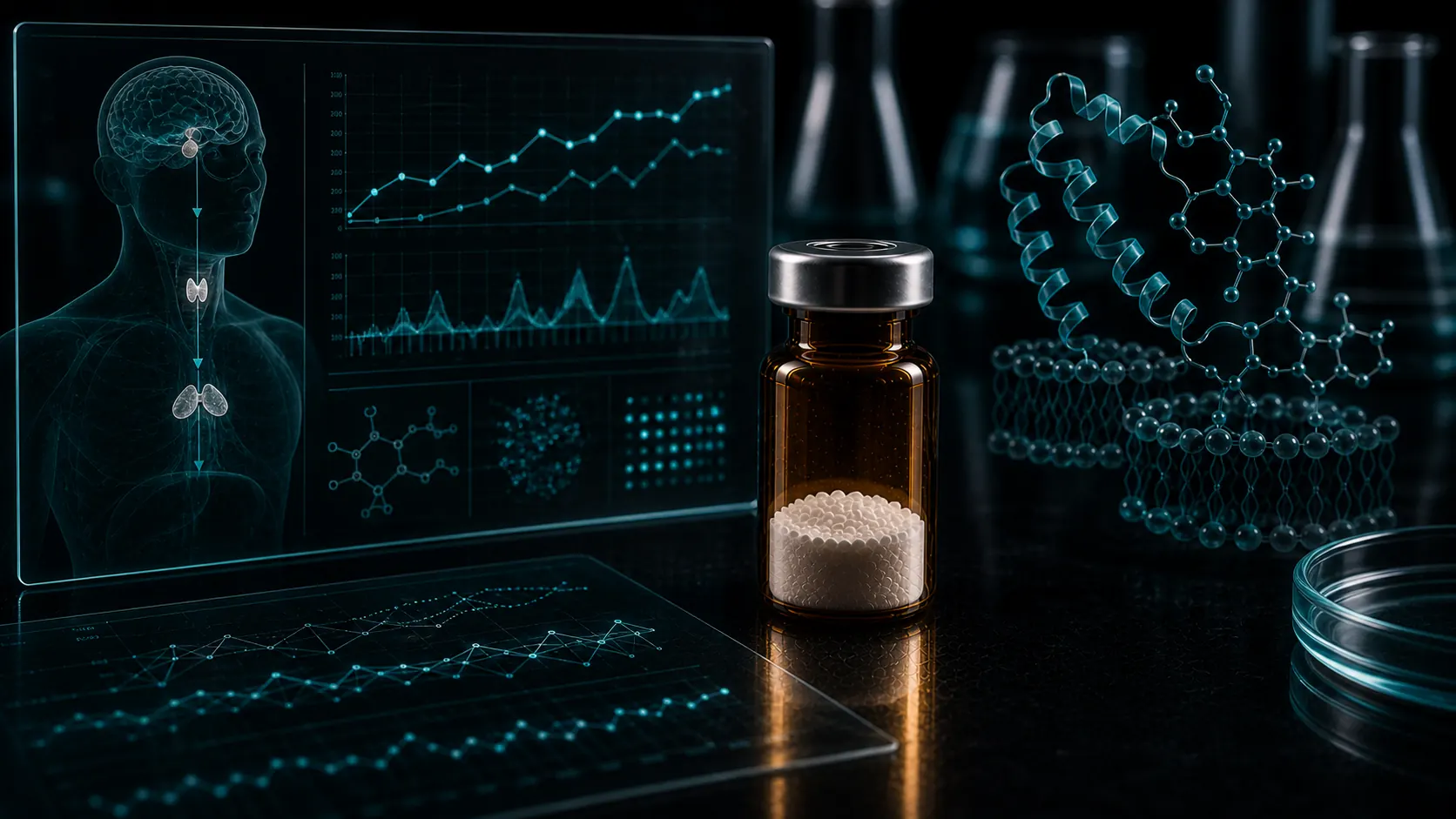
Ipamorelin is described almost everywhere as a "selective growth hormone secretagogue." That phrase is doing a lot of work, and most product pages do not unpack it. This guide explains the mechanism in plain language: what receptor ipamorelin acts on, why that receptor exists, what "selective" actually refers to, and why a receptor description is not the same as a proven health benefit.
For the molecule basics, start with the ipamorelin peptide guide. If you want the safety and regulatory picture, the ipamorelin side effects and FDA status review covers that side. This article stays on the mechanism question.
Mechanism Snapshot
| Step | What research describes | Reading note |
|---|---|---|
| Binding target | Ipamorelin acts as an agonist at the growth hormone secretagogue receptor type 1a (GHS-R1a), the same receptor activated by the natural hormone ghrelin. | This is a receptor-level description from pharmacology research, not a clinical outcome. |
| Signal | GHS-R1a is a G protein-coupled receptor. Its activation drives intracellular calcium signaling in pituitary somatotroph cells, prompting release of stored growth hormone. | Releasing stored hormone is not the same as supplying recombinant growth hormone. |
| Selectivity | In the original animal pharmacology, ipamorelin released growth hormone without significant rises in ACTH, cortisol, or prolactin, even at high multiples of its GH-releasing dose. | Selectivity was characterized largely in preclinical models, not in long-term human use. |
| Pathway position | The ghrelin-receptor route is distinct from the GHRH-receptor route used by sermorelin, CJC-1295, and tesamorelin. | Sharing the GH axis does not make these molecules interchangeable. |
What Ipamorelin Is
Ipamorelin is a synthetic pentapeptide, meaning a short chain of five amino acids. It was first described by Raun and colleagues in 1998 and developed in the context of growth-hormone secretagogue research. The original paper called it the first selective growth hormone secretagogue, a label that has followed the molecule ever since.
A secretagogue is simply a substance that prompts a gland to secrete something it already makes and stores. Ipamorelin does not deliver growth hormone into the body. Instead, it signals the pituitary gland to release growth hormone that the body has already produced. That distinction matters, because it is the difference between nudging a natural pulse and injecting a finished hormone product.
The Ghrelin Receptor It Targets
Ipamorelin acts as an agonist at the growth hormone secretagogue receptor type 1a, usually written as GHS-R1a. This receptor was cloned and characterized in the mid-1990s, before its natural ligand was even known. That natural ligand turned out to be ghrelin, a stomach-derived hormone identified by Kojima and colleagues in 1999. Because ipamorelin activates the same receptor that ghrelin uses, it is often called a ghrelin mimetic.
GHS-R1a is a G protein-coupled receptor expressed in the pituitary and hypothalamus. When an agonist binds it, the receptor drives intracellular calcium signaling inside pituitary somatotroph cells. That calcium signal is part of the cascade that triggers release of stored growth hormone. This is the core mechanistic claim that is well supported by pharmacology literature: ipamorelin engages a real, well-defined receptor that participates in growth hormone release.
Be precise about what this does and does not establish. Receptor binding and a growth hormone pulse are pharmacodynamic observations. They explain how the molecule could plausibly act. They do not, on their own, demonstrate that any downstream goal, such as fat loss, muscle gain, or better sleep, follows in humans.
Why It Is Called "Selective"
The word "selective" in ipamorelin's description has a specific meaning, and it is easy to misread. It does not mean ipamorelin selectively burns fat, or selectively targets one tissue. It refers to its hormonal profile.
Earlier growth hormone releasing peptides, such as GHRP-2 and GHRP-6, raise growth hormone but also tend to raise other pituitary hormones, including ACTH and cortisol, and can affect prolactin. In the original animal pharmacology, ipamorelin released growth hormone while producing little to no significant rise in ACTH, cortisol, or prolactin, even at doses well above its growth-hormone-releasing threshold. That cleaner hormonal profile is what "selective" describes.
Two cautions belong with this point. First, much of the selectivity characterization comes from preclinical and short-term study settings, not from long-term human dosing. Second, a favorable selectivity profile in research is not the same as a safety guarantee in consumer products, which differ by route, formulation, purity, and population. The GHRP-2 and GHRP-6 evidence guide covers the comparison peptides in more detail.
Ghrelin Pathway Versus GHRH Pathway
Growth hormone release is governed by more than one input. Two of the relevant signaling routes are the GHRH pathway and the ghrelin pathway. They are not the same, and this is where a lot of online confusion starts.
GHRH analogs act on the GHRH receptor. Sermorelin, CJC-1295, and tesamorelin all sit in that family. Ipamorelin is different: it acts on the ghrelin receptor, GHS-R1a. The two routes are frequently described as complementary because they engage growth hormone control through separate receptors, which is part of why CJC-1295 and ipamorelin are so often paired in online stacks.
Complementary mechanism is a hypothesis-level rationale, not proof of a combined benefit. A pairing can make biological sense and still lack direct human outcome data, adverse-event reporting, and product-quality controls for the specific combination being sold. The growth-hormone peptide comparison walks through why pathway overlap does not transfer dosing, safety, or efficacy assumptions between molecules. Among this group, only tesamorelin carries an FDA-approved label, for a narrow indication; ipamorelin has no approved U.S. label in the sources used here.
Mechanism Is Not Outcome
Keep mechanism and outcome in separate boxes. A clear mechanism is a starting point for research, not a finish line for claims.
The human evidence base is narrow. There is a published human volunteer pharmacokinetic and pharmacodynamic study that measured ipamorelin levels and growth hormone response under controlled, intravenous conditions. There is also a randomized Phase 2 trial that tested intravenous ipamorelin for postoperative ileus after bowel surgery, a question very different from wellness or body composition. That trial did not show statistically significant benefit on its key efficacy analyses. Neither study validates the broad fat-loss, recovery, anti-aging, or sleep claims commonly attached to the molecule.
Regulatory context reinforces the gap. FDA briefing materials note that there are no FDA-approved drug products containing ipamorelin, and ipamorelin acetate appears among bulk substances flagged for potential safety risks in compounding, including immunogenicity concerns tied to aggregation and peptide-related impurities for injectable routes. A working receptor mechanism does not erase those product-quality and approval questions. The how to read a peptide study guide is useful here, because ipamorelin is a good example of a molecule with strong mechanism literature and thin human outcome data.
The honest summary is narrow on purpose. Ipamorelin's mechanism is well described: it is a selective ghrelin-receptor (GHS-R1a) agonist that prompts pituitary growth hormone release with a comparatively clean hormonal profile in research models. What that mechanism does not establish is a list of confirmed human benefits, a safety profile across consumer products, or any FDA-approved use.
Frequently Asked Questions
Is ipamorelin the same as growth hormone? No. It does not contain or supply growth hormone. It is a secretagogue that signals the pituitary to release growth hormone the body already makes and stores.
What does "selective" mean here? It refers to the hormonal profile. In research models, ipamorelin released growth hormone without significant increases in ACTH, cortisol, or prolactin, unlike some earlier growth hormone releasing peptides. It does not mean tissue-selective fat loss.
How is ipamorelin different from CJC-1295 or sermorelin? Ipamorelin works through the ghrelin receptor (GHS-R1a). CJC-1295 and sermorelin are GHRH analogs that work through the GHRH receptor. They engage the same axis through different receptors and are not interchangeable.
Does the mechanism prove ipamorelin works for fat loss or recovery? No. Receptor binding and a growth hormone pulse are pharmacology observations. They do not, by themselves, confirm body-composition, recovery, sleep, or anti-aging outcomes in people.
References
- Ipamorelin, the first selective growth hormone secretagogue, European Journal of Endocrinology / PubMed.
- Pharmacokinetic-Pharmacodynamic Modeling of Ipamorelin, a Growth Hormone Releasing Peptide, in Human Volunteers, Pharmaceutical Research / PubMed.
- A receptor in pituitary and hypothalamus that functions in growth hormone release, Science (Howard et al., GHS-R cloning) / PubMed.
- Ghrelin is a growth-hormone-releasing acylated peptide from stomach, Nature (Kojima et al.) / PubMed.
- Ghrelin, the growth hormone secretagogue receptor, and the regulation of growth hormone secretion (review), Endocrine Reviews / PubMed.
- Prospective, randomized, controlled, proof-of-concept study of the ghrelin mimetic ipamorelin for postoperative ileus, International Journal of Colorectal Disease / PubMed.
- Pharmacy Compounding Advisory Committee briefing document for ipamorelin-related bulk drug substances, U.S. Food and Drug Administration.
- Certain Bulk Drug Substances for Use in Compounding that May Present Significant Safety Risks, U.S. Food and Drug Administration.
Disclaimer
This page is educational and is not medical advice. It does not provide dosing, injection, reconstitution, compounding, sourcing, purchasing, bodybuilding, anti-aging, sleep, recovery, or individualized treatment guidance for ipamorelin or related products. Decisions about growth-hormone pathway drugs, peptide products, adverse symptoms, and medication changes should be made with qualified healthcare professionals using current regulator-reviewed information.
Next steps
Continue with the closest guide, peptide profile, or research tool.