Mechanism and label context
Tesamorelin Mechanism Explained: GHRH Analog, FDA-Approved Use, and Off-Label Limits
A source-backed guide to how tesamorelin works as a GHRH analog, its single FDA-approved HIV-lipodystrophy use, IGF-1 effects, and why anti-aging claims are off-label.
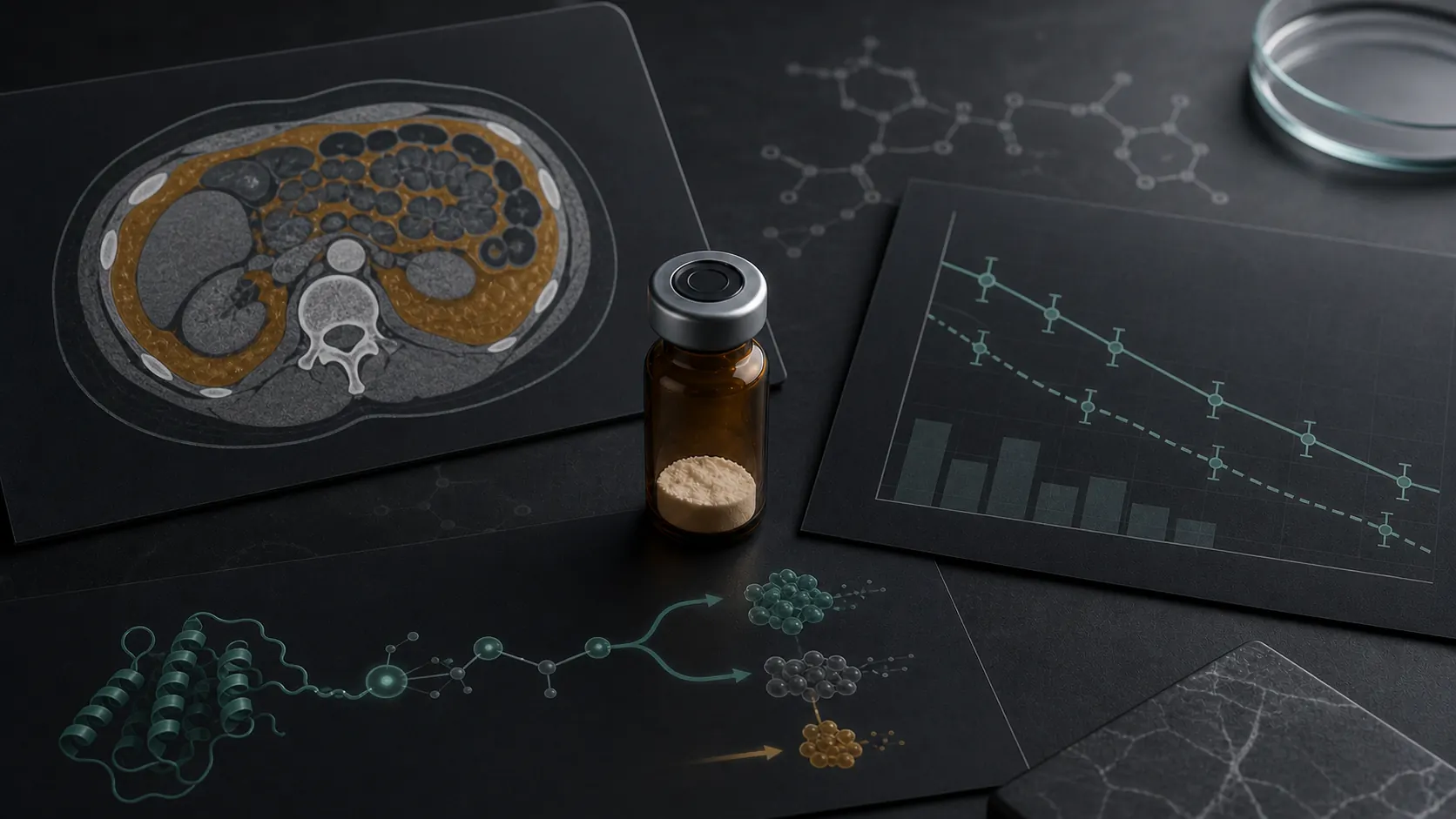
Tesamorelin gets described in two very different ways online. In clinical literature it is a narrow, FDA-approved prescription drug with a defined mechanism. In peptide-market copy it is often reframed as a general "growth hormone peptide" for anti-aging or physique. Understanding the actual mechanism is the cleanest way to see where the approved evidence ends and the marketing begins.
This page focuses on how tesamorelin works as a growth hormone-releasing hormone (GHRH) analog, what its single FDA-approved indication is, and why the popular anti-aging and bodybuilding framing is off-label. For a molecule-level profile, start with the tesamorelin guide. For the visceral-fat evidence specifically, see Tesamorelin for Visceral Fat.
Evidence Snapshot
| Claim | Evidence picture | Boundary |
|---|---|---|
| Tesamorelin is a synthetic growth hormone-releasing hormone (GHRH) analog. | FDA labeling and the original development literature describe tesamorelin as a stabilized analog of human GHRH (growth hormone-releasing factor). | It acts on the pituitary GHRH receptor; it is not recombinant growth hormone, a GLP-1 drug, or an amylin analog. |
| Tesamorelin raises growth hormone and IGF-1. | Human trials show tesamorelin stimulates endogenous pituitary GH secretion, which increases circulating IGF-1. | Higher IGF-1 is a measured pharmacologic effect, not proof of any anti-aging or muscle-building benefit. |
| Tesamorelin is FDA-approved. | EGRIFTA formulations are approved for reduction of excess abdominal fat in HIV-infected adults with lipodystrophy. | The approval is indication-specific and the label states it is not indicated for weight-loss management. |
| Tesamorelin is an anti-aging or bodybuilding peptide. | There is no FDA-approved anti-aging, longevity, or performance indication for tesamorelin. | Anti-aging and physique claims are off-label and are not supported by the approved evidence base. |
| Research-market tesamorelin is the same as EGRIFTA. | The mechanism and label evidence apply to regulated, characterized tesamorelin products. | Unapproved products can differ in identity, purity, sterility, concentration, excipients, and storage history. |
What Tesamorelin Is
Tesamorelin is a synthetic analog of human growth hormone-releasing hormone (GHRH), also called growth hormone-releasing factor. Natural GHRH is a hypothalamic peptide that travels to the anterior pituitary and signals it to release growth hormone. Tesamorelin is a stabilized version of that signal, modified so it resists rapid breakdown and can be given as a daily subcutaneous injection.
In the United States, the FDA-approved tesamorelin products are the EGRIFTA formulations. DailyMed labeling lists the indication as reduction of excess abdominal fat in HIV-infected adult patients with lipodystrophy. That is a single, specific indication, not a general metabolic or wellness license.
How The Mechanism Works
Tesamorelin binds the GHRH receptor on pituitary somatotroph cells. That binding prompts the pituitary to release its own stored growth hormone (GH). The released GH then acts on the liver and other tissues, which increases production of insulin-like growth factor 1 (IGF-1). Much of GH's downstream effect on tissue is mediated through IGF-1.
Tesamorelin works upstream. It stimulates the body's own pituitary output rather than supplying hormone directly. Because GH release stays under the influence of normal pituitary feedback, including suppression by somatostatin, the resulting pattern is closer to the body's pulsatile GH rhythm than a steady external dose would be. In HIV-lipodystrophy trials, this GHRH-axis stimulation was associated with reductions in visceral adipose tissue, the endpoint that drove approval.
This places tesamorelin in the same broad family as other GHRH analogs and growth hormone secretagogues. Sermorelin is another GHRH analog, and CJC-1295 is a longer-acting GHRH analog, while ipamorelin works through a separate ghrelin-receptor pathway. They share the theme of nudging endogenous GH rather than replacing it. For a side-by-side, see CJC-1295 vs Ipamorelin vs Sermorelin vs Tesamorelin.
GHRH Analog vs Recombinant Growth Hormone
A common confusion is treating tesamorelin as if it were synthetic growth hormone. It is not. Recombinant human growth hormone (rHGH) is the hormone itself, injected directly, which bypasses pituitary regulation. Tesamorelin is the upstream releasing signal that tells the pituitary to secrete its own GH.
That distinction matters for how the two are studied, dosed, and monitored. Because tesamorelin depends on a functioning pituitary, it would not be expected to work in someone whose GHRH-GH axis is disrupted, which is reflected in its contraindications. It also means the drug's effect is constrained by the body's own feedback, rather than overriding it the way a direct hormone dose can. None of this makes tesamorelin automatically safer; it simply means it is a different pharmacologic tool with its own evidence base.
The One FDA-Approved Use
Tesamorelin's approval rests on randomized trials in adults with HIV-associated abdominal fat accumulation. A 2007 New England Journal of Medicine study and later phase 3 trials published in JCEM and JAIDS measured visceral adipose tissue, usually with imaging, and reported reductions versus placebo. A JAMA trial extended the work to visceral fat and liver fat in the same population.
On the strength of that data, the FDA-approved indication is reduction of excess abdominal fat in HIV-infected adults with lipodystrophy. The label is explicit about its limits: long-term cardiovascular safety has not been established, the product is not indicated for weight-loss management, and there are no data showing improved adherence to antiretroviral therapy. The approved population, endpoint, and claim are all narrow on purpose.
Why Anti-Aging And Physique Claims Are Off-Label
Because tesamorelin raises GH and IGF-1, it is frequently marketed for anti-aging, longevity, muscle gain, recovery, or general fat loss. The mechanism makes those claims sound plausible, but plausibility is not approval. There is no FDA-approved anti-aging, longevity, or performance indication for tesamorelin, and the human trials that support it were conducted in people with HIV-associated lipodystrophy, not healthy adults seeking cosmetic or athletic benefits.
Raising IGF-1 is a measured pharmacologic effect, not a proven health benefit. A higher IGF-1 number does not establish that someone will age more slowly, build more muscle, or recover faster, and chronically elevated IGF-1 carries its own theoretical risk concerns. Treating "it increases GH and IGF-1" as if it were the same as "it makes you younger or more muscular" is the central logical leap in most off-label copy. For how to read this kind of evidence, see How to Read a Peptide Study and Approved vs Investigational vs Compounded vs Research Peptides.
IGF-1, Safety, And Monitoring
The same mechanism that defines tesamorelin also defines its cautions. EGRIFTA labeling includes contraindications such as disruption of the hypothalamic-pituitary axis due to pituitary tumor, hypopituitarism, pituitary surgery, head irradiation, or head trauma; active malignancy; known hypersensitivity to tesamorelin or its excipients; and pregnancy.
Label-level warnings include elevated IGF-1, neoplasm-related concerns, fluid retention, glucose intolerance or new or worsening diabetes mellitus, hypersensitivity reactions, injection-site reactions, and increased mortality reported with GH in patients who have acute critical illness. Common adverse reactions listed for EGRIFTA WR include arthralgia, injection-site reactions, pain in extremity, peripheral edema, and myalgia. Because the drug deliberately raises IGF-1, clinical use is tied to monitoring, not casual self-experimentation. These warnings are mechanism-driven, which is exactly why they apply regardless of how a product is marketed.
Reader Checklist
Before trusting a tesamorelin claim, ask:
- Does the source describe tesamorelin as a GHRH analog that stimulates the pituitary, or does it confuse it with direct growth hormone?
- Is the claim tied to the approved indication (HIV-associated lipodystrophy) or to off-label anti-aging or physique goals?
- Does the source treat raised IGF-1 as a benefit by itself, or acknowledge it is just a measured effect?
- Are the cited studies in the studied HIV population, or generalized to healthy adults?
- Does the source mention contraindications such as malignancy, pituitary-axis disruption, and pregnancy?
- Is the product an FDA-approved EGRIFTA formulation, a compounded preparation, or a research-market vial?
Tesamorelin is a GHRH analog with a real but narrow FDA-approved use in HIV-associated lipodystrophy and a well-characterized mechanism. The anti-aging and bodybuilding versions of the story borrow that mechanism without the matching evidence or approval.
References
- EGRIFTA WR (tesamorelin) prescribing information, FDA / DailyMed.
- EGRIFTA SV (tesamorelin) prescribing information, FDA / DailyMed.
- Metabolic effects of a growth hormone-releasing factor in patients with HIV, New England Journal of Medicine / PubMed.
- Effects of tesamorelin (TH9507), a growth hormone-releasing factor analog, in HIV-infected patients with excess abdominal fat, Journal of Clinical Endocrinology & Metabolism / PubMed.
- Effects of tesamorelin, a growth hormone-releasing factor, in HIV-infected patients with abdominal fat accumulation, Journal of Acquired Immune Deficiency Syndromes / PubMed.
- Effect of tesamorelin on visceral fat and liver fat in HIV-infected patients with abdominal fat accumulation, JAMA / PubMed.
- Tesamorelin, a growth hormone-releasing factor analogue, in HIV-associated lipodystrophy (review), Clinical Infectious Diseases / PubMed.
- Growth hormone-releasing hormone: clinical and basic physiology, Endocrine Reviews / PubMed.
Disclaimer
This page is educational and is not medical advice. It does not provide dosing, reconstitution, injection, compounding, sourcing, purchase, or treatment instructions for tesamorelin. Tesamorelin decisions should be made with a qualified healthcare professional using the approved product label, personal medical history, and appropriate monitoring.
Next steps
Continue with the closest guide, peptide profile, or research tool.