Skin and collagen evidence
GHK-Cu and Collagen: Anti-Aging Skin Evidence and Its Limits
A source-backed look at GHK-Cu collagen and anti-aging claims, separating fibroblast and gene-level lab data from small human cosmetic studies and their limits.
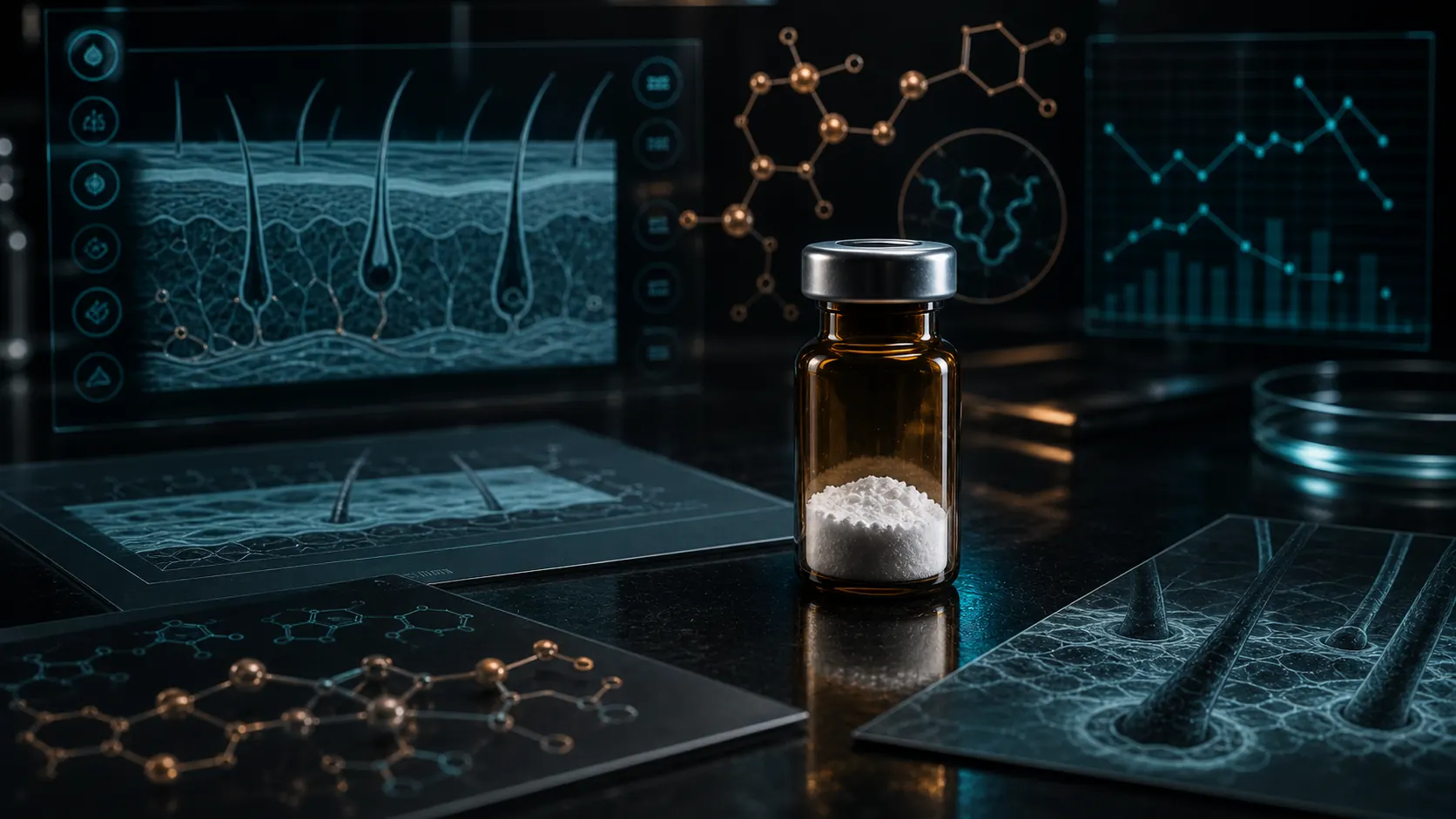
GHK-Cu is probably the most famous copper peptide in skin care, and almost all of that fame comes back to one idea: that it boosts collagen. Marketing pages promise firmer, denser, younger-looking skin, and they often cite real research to do it. The science is not invented. The harder question is how much of it has been demonstrated in actual people using an actual product.
This page focuses on that gap. It separates the laboratory collagen story from the smaller body of human cosmetic data, and it explains why a strong mechanism in a dish does not automatically translate into a measurable anti-aging result on a face.
For molecule basics and route distinctions, start with the GHK-Cu peptide guide and the companion article on topical evidence and injectable risks. Here we go deeper on the collagen and anti-aging claim itself.
Evidence Snapshot
| Common claim | Evidence picture | Boundary |
|---|---|---|
| GHK-Cu boosts collagen synthesis. | Cell-culture work since the late 1980s shows GHK-Cu stimulates collagen production by skin fibroblasts at very low concentrations. | A fibroblast-culture result is a mechanism signal, not proof that a finished cream rebuilds dermal collagen in a person. |
| GHK-Cu reverses skin aging. | Small cosmetic studies of GHK-Cu creams have reported improvements in skin density, firmness, and fine lines over weeks. | Several key studies are industry-linked conference reports with modest size, so the certainty is limited and formulation-specific. |
| GHK-Cu is an antioxidant that fights inflammaging. | Reviews describe GHK and GHK-Cu modulating antioxidant enzymes, metalloproteinases, and inflammatory signaling in lab systems. | Most antioxidant and gene-modulation data are in vitro or computational, not human anti-aging endpoints. |
| GHK-Cu works as well as retinoids. | Marketing pages compare copper peptides with retinol, but head-to-head, well-powered human comparisons are scarce. | Comparative cosmetic claims need direct, blinded trials with objective endpoints, not mechanism analogies. |
| The collagen science is just hype. | GHK-Cu has a genuine, decades-old PubMed literature on extracellular-matrix biology and wound repair. | Real mechanism still does not settle dose, delivery, or how much visible change a specific product produces. |
Where The Collagen Story Comes From
GHK is a tripeptide made of glycine, histidine, and lysine. It occurs naturally in human plasma, where reported levels fall with age, and it binds copper to form the GHK-Cu complex. One reason researchers became interested is that the GHK sequence appears within the alpha-2 chain of type I collagen, which led to the idea that the peptide may be released from the matrix during injury and act as a local repair signal.
That framing matters. The collagen claim did not begin as cosmetic marketing. It began as wound-healing and connective-tissue biology, and the cosmetic industry later borrowed it. Understanding the original context helps explain why the mechanism is plausible while the everyday-skin-care outcomes remain less certain.
What The Lab Evidence Shows
The foundational finding is old and has held up well. A 1988 study in fibroblast cultures reported that GHK-Cu stimulates collagen synthesis, with effects appearing at extremely low concentrations and not explained simply by more cells growing. That is a reproducible mechanism signal in a controlled cell system.
Later reviews broadened the picture. GHK and GHK-Cu have been described as modulating the extracellular matrix more generally: influencing collagen and glycosaminoglycan turnover, the balance of matrix metalloproteinases and their inhibitors, and the activity of fibroblasts and keratinocytes. Work using gene-expression data has reported that GHK-Cu can shift the activity of large numbers of genes, including ones tied to tissue remodeling, antioxidant defense, and DNA repair.
A separate cell study looked at copper tripeptide and growth-factor expression in normal and irradiated fibroblasts, supporting the idea that the peptide can influence repair-related signaling under stress. The laboratory literature here runs decades deep.
The caveat is that nearly all of this is in vitro or computational. Cells in a dish, gene-expression arrays, and isolated matrix proteins answer mechanistic questions. They do not establish how much peptide reaches living dermis from a cream, how long it stays active, or how much visible change a person should expect.
Antioxidant And Anti-Inflammatory Claims
A second popular claim is that GHK-Cu fights "inflammaging" through antioxidant and anti-inflammatory activity. Reviews describe GHK-Cu interacting with antioxidant enzyme systems and with inflammatory signaling pathways, and copper chemistry gives the idea surface plausibility because copper participates in several redox-related enzymes.
This is an area where wording gets stretched online. Some pages list specific cytokines suppressed or master pathways switched, presented as settled human biology. In reality, much of that detail comes from cell systems, animal models, or mechanistic reviews rather than controlled trials measuring inflammation or aging endpoints in human skin. The mechanism can be cited honestly only if it is labeled as mechanism, not as a proven clinical outcome.
What Human Cosmetic Studies Actually Found
The clinical confidence in topical GHK-Cu rests on a small number of cosmetic studies. The most-cited is a roughly 12-week evaluation of a copper-peptide facial cream in about 70 women with photoaged skin, reported to improve skin density, firmness, clarity, and the appearance of fine lines versus a control. A companion eye-cream study in a smaller group reported benefit over placebo and over a vitamin K comparator.
These results are frequently presented as definitive proof. They should be read more carefully. Several of the headline studies were presented at industry meetings rather than published as full, independently peer-reviewed trials, the sample sizes were modest, and the products were specific commercial formulations. That does not make the findings worthless, but it does mean the certainty is lower than a casual reader would assume from the confident language on retail pages.
Broader cosmetic-science reviews reach a measured conclusion: topical peptides including GHK-Cu show some anti-wrinkle and skin-conditioning signal in human work, while delivery, stability, and formulation remain real challenges. The Cosmetic Ingredient Review safety assessment, in turn, treats Copper Tripeptide-1 as a cosmetic ingredient under described use conditions, not as an anti-aging drug with proven disease-modifying effects.
Why The Lab-To-Skin Gap Persists
GHK-Cu has strong mechanistic evidence and modest clinical evidence, and the two are often blurred. A fibroblast culture can prove that the peptide can stimulate collagen. It cannot prove that a particular serum, at a particular concentration, in a particular base, delivered through intact skin, produces a meaningful change you would notice in a mirror.
Several gaps explain why. Skin penetration of a charged copper-peptide complex is not guaranteed and depends heavily on formulation. Cosmetic endpoints such as "firmness" or "radiance" are partly subjective and sensitive to moisturization alone. And comparative claims, such as GHK-Cu matching retinoids, generally rest on mechanism analogies rather than well-powered head-to-head trials.
None of this means copper peptides are a scam. It means the appropriate claim is narrow: a credible collagen and matrix mechanism, plus limited human cosmetic data suggesting some visible benefit from specific products, with the strongest outcome claims still outrunning the strongest evidence. For a wider view of how peptide marketing gets ahead of data, see how to read a peptide study.
Reader Checklist
Before trusting a GHK-Cu collagen or anti-aging claim, ask:
- Is the cited evidence a cell-culture study, a gene-expression analysis, an animal model, a human cosmetic trial, or a seller page?
- Does a "boosts collagen" claim come from fibroblast cultures rather than from measured change in human dermis?
- Are the human studies full peer-reviewed trials, or industry conference abstracts with small samples?
- Does the claim attach to a specific finished product, concentration, and delivery system?
- Are antioxidant and anti-inflammatory statements labeled as mechanism rather than proven human anti-aging outcomes?
- Does a comparison with retinoids rest on a real head-to-head trial or just on mechanism analogy?
- Does the source keep cosmetic topical evidence separate from injectable or systemic claims?
GHK-Cu earns its place in the collagen conversation through real biology, but the loudest anti-aging promises still rest on small, formulation-specific human data. Treat the mechanism as interesting and the cosmetic outcomes as plausible but modest, and judge any individual product on its own evidence.
References
- Stimulation of collagen synthesis in fibroblast cultures by the tripeptide-copper complex glycyl-L-histidyl-L-lysine-Cu2+, FEBS Letters / PubMed.
- GHK Peptide as a Natural Modulator of Multiple Cellular Pathways in Skin Regeneration, BioMed Research International / PubMed.
- Regenerative and Protective Actions of the GHK-Cu Peptide in the Light of the New Gene Data, International Journal of Molecular Sciences / PubMed.
- The human tri-peptide GHK and tissue remodeling, Journal of Biomaterials Science, Polymer Edition / PubMed.
- Effects of Copper Tripeptide on the Growth and Expression of Growth Factors by Normal and Irradiated Fibroblasts, Archives of Facial Plastic Surgery.
- The potential of GHK as an anti-aging peptide, Aging Pathobiology and Therapeutics / PubMed.
- Role of topical peptides in preventing or treating aged skin, International Journal of Cosmetic Science / PubMed.
- Safety Assessment of Tripeptide-1, Hexapeptide-12, Their Metal Salts and Fatty Acyl Derivatives, and Palmitoyl Tetrapeptide-7 as Used in Cosmetics, International Journal of Toxicology / Cosmetic Ingredient Review.
- Cosmetic Ingredients, U.S. Food and Drug Administration.
Disclaimer
This page is educational and is not medical advice. It does not provide dosing, injection, reconstitution, compounding, sourcing, purchasing, or skin-treatment instructions for GHK-Cu. Skin aging, skin disease, cosmetic-product reactions, and peptide-product decisions should be discussed with qualified healthcare professionals using current regulator-reviewed information.
Next steps
Continue with the closest guide, peptide profile, or research tool.