Measurement literacy
Peptide Reconstitution Math Explained: mg, mcg, mL, Units, and Concentration
A measurement-first guide to peptide reconstitution math, including concentration, milligrams, micrograms, milliliters, syringe units, and common calculation mistakes.
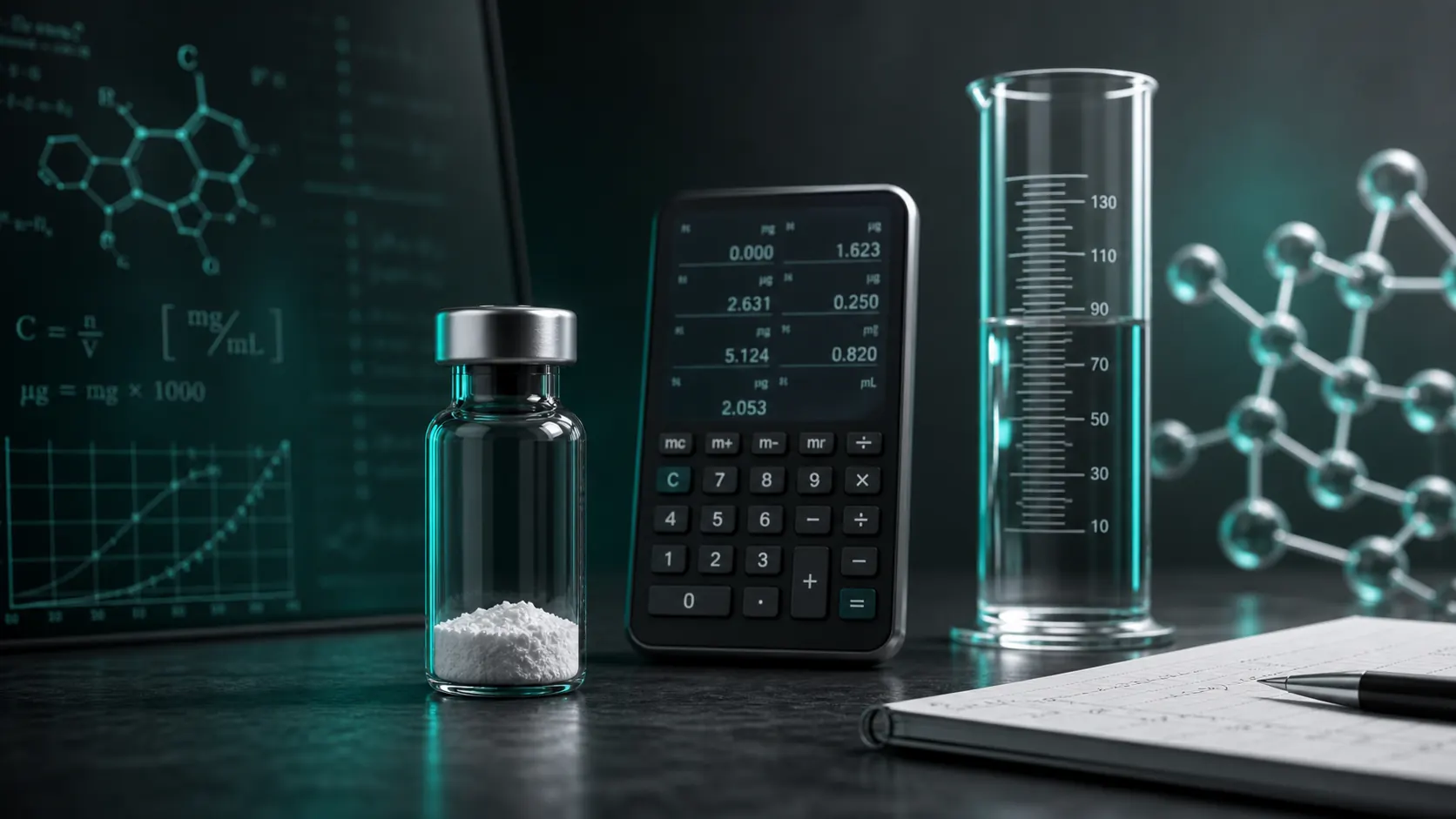
Peptide reconstitution math is usually described as a calculator problem. It is really a units problem. The same vial amount can produce very different concentrations depending on how much liquid is added, and the same syringe marking can represent different peptide masses depending on that concentration.
This article explains measurement language only. It is not a dosing guide, injection guide, storage protocol, product recommendation, or substitute for instructions from a licensed clinician or pharmacist.
The Core Idea
Reconstitution changes a dry vial amount into a liquid concentration. The vial tells you mass, such as milligrams. The added water tells you volume, such as milliliters. Concentration connects the two.
The core relationship is:
Concentration = total peptide amount / total liquid volume
Once concentration is known, a volume marking on a syringe can be converted into a peptide amount. Without concentration, a syringe marking alone is incomplete information.
Unit Table
| Unit | Meaning | Common error |
|---|---|---|
| Milligram (mg) | A mass unit. 1 mg equals 1,000 micrograms. | Reading mg as if it were a liquid volume. |
| Microgram (mcg or ug) | A smaller mass unit. 1 mcg equals 0.001 mg. | Confusing mcg with mg, which creates a 1,000-fold error. |
| Milliliter (mL) | A liquid volume unit. It tells you how much liquid is drawn up. | Treating mL as if it tells you dose without knowing concentration. |
| Concentration | How much peptide mass is present per liquid volume, usually mg/mL or mcg/mL. | Changing water volume without recalculating concentration. |
| U-100 syringe unit | A syringe marking based on U-100 insulin calibration: 100 markings per 1 mL. | Assuming "units" are peptide dose units rather than volume markings. |
The Formula
For measurement literacy, three formulas cover most calculator checks:
- mg/mL = vial mg / water mL
- mcg/mL = mg/mL x 1,000
- volume mL = desired amount / concentration
For a U-100 syringe, the volume relationship is usually:
1 unit = 0.01 mL and 100 units = 1 mL
That statement is about the syringe marking system, not a peptide-specific dose. U-100 markings come from insulin calibration. When people use those markings for non-insulin liquids, they are using the markings as a volume scale.
Worked Examples Using Fictional Math
These examples are for arithmetic only. They are not recommended doses, protocols, or instructions for any specific peptide.
Example A: A fictional 10 mg vial is mixed with 2 mL of liquid.
- 10 mg / 2 mL = 5 mg/mL
- 5 mg/mL x 1,000 = 5,000 mcg/mL
- On a U-100 syringe, 10 units = 0.10 mL
- 0.10 mL x 5,000 mcg/mL = 500 mcg
Example B: A fictional 5 mg vial is mixed with 2.5 mL of liquid.
- 5 mg / 2.5 mL = 2 mg/mL
- 2 mg/mL x 1,000 = 2,000 mcg/mL
- On a U-100 syringe, 25 units = 0.25 mL
- 0.25 mL x 2,000 mcg/mL = 500 mcg
Notice that both examples reach 500 mcg with different syringe markings because the concentrations are different. That is why copying a unit number from someone else without knowing vial amount and liquid volume can create a serious error.
Syringe Units Are Volume Markings
U-100 insulin syringes are commonly discussed in peptide forums because the markings are small and familiar. But "units" on that syringe are not peptide units. They are markings based on a 100 units/mL insulin standard.
This is a major source of confusion. A person may say "20 units" as if it is a dose. In measurement terms, 20 units on a U-100 syringe is 0.20 mL. The amount of peptide in that 0.20 mL depends entirely on concentration.
The safest writing habit is to state both volume and concentration. For example: "0.20 mL from a solution containing 5 mg/mL" is clearer than "20 units."
Common Calculation Errors
FDA warnings around compounded injectable semaglutide products are useful because they show how real-world dosing errors can happen when patients receive vials, variable concentrations, and instructions that require measurement. Reported issues include confusion around units, milliliters, and dose calculation.
The most common math mistakes are:
- Confusing milligrams with micrograms.
- Using a syringe-unit number without converting it to mL.
- Changing water volume but keeping the old unit number.
- Assuming every vial with the same peptide name has the same concentration.
- Copying a forum example without the vial amount, liquid volume, and syringe type.
- Using unclear abbreviations such as "U" when "units" or "mL" should be written out.
How To Check A Calculator Result
A reconstitution calculator should ask for at least three things: vial amount, liquid volume, and target amount. A stronger calculator also makes syringe type explicit, shows concentration, and displays both mL and syringe markings.
Before trusting the output, ask:
- Are all masses in the same unit before calculation?
- Is the water volume the final liquid volume being used for concentration?
- Does the calculator show mg/mL or mcg/mL?
- Does the syringe conversion match the actual syringe type?
- Does the result make sense if converted back manually?
Our reconstitution calculator is designed around those inputs. The calculator still cannot validate a product, prescription, route, storage condition, or clinical decision. It can only help with arithmetic once the inputs are correct.
FAQ
Does reconstitution math tell you whether a peptide is safe?
No. The math only converts mass, liquid volume, and syringe markings. It does not verify identity, sterility, purity, route, legality, or whether a product is appropriate for use.
What is the most common unit mistake?
Mixing milligrams and micrograms is a common source of large errors. One milligram equals 1,000 micrograms, so every calculation should make the unit conversion explicit.
Why use fictional examples?
Fictional examples teach the arithmetic without turning the article into a dosing protocol for any specific peptide or person.
References
- FDA Alerts Health Care Providers, Compounders and Patients of Dosing Errors Associated with Compounded Injectable Semaglutide Products, U.S. Food and Drug Administration.
- FDA's Concerns with Unapproved GLP-1 Drugs Used for Weight Loss, U.S. Food and Drug Administration.
- Medications Containing Semaglutide Marketed for Type 2 Diabetes or Weight Loss, U.S. Food and Drug Administration.
- SI Units, National Institute of Standards and Technology.
- SI Prefixes, National Institute of Standards and Technology.
- Guide for the Use of the International System of Units (SI), National Institute of Standards and Technology.
- ISMP List of Error-Prone Abbreviations, Symbols, and Dose Designations, Institute for Safe Medication Practices.
- Measuring Liquid Medicines Safely, ConsumerMedSafety.org.
- Liquid Medicines, ConsumerMedSafety.org.
- Giving an Insulin Injection, MedlinePlus.
- DailyMed Drug Labeling Database, National Library of Medicine.